
Capital, the State, and the Customer-ized Academy: The Bilgi University Resistance and the Attacks on the Nests of Enlightenment
In the Light of the Bilgi University Resistance, the Commodification of Education and the Academy Beyond the Barricade
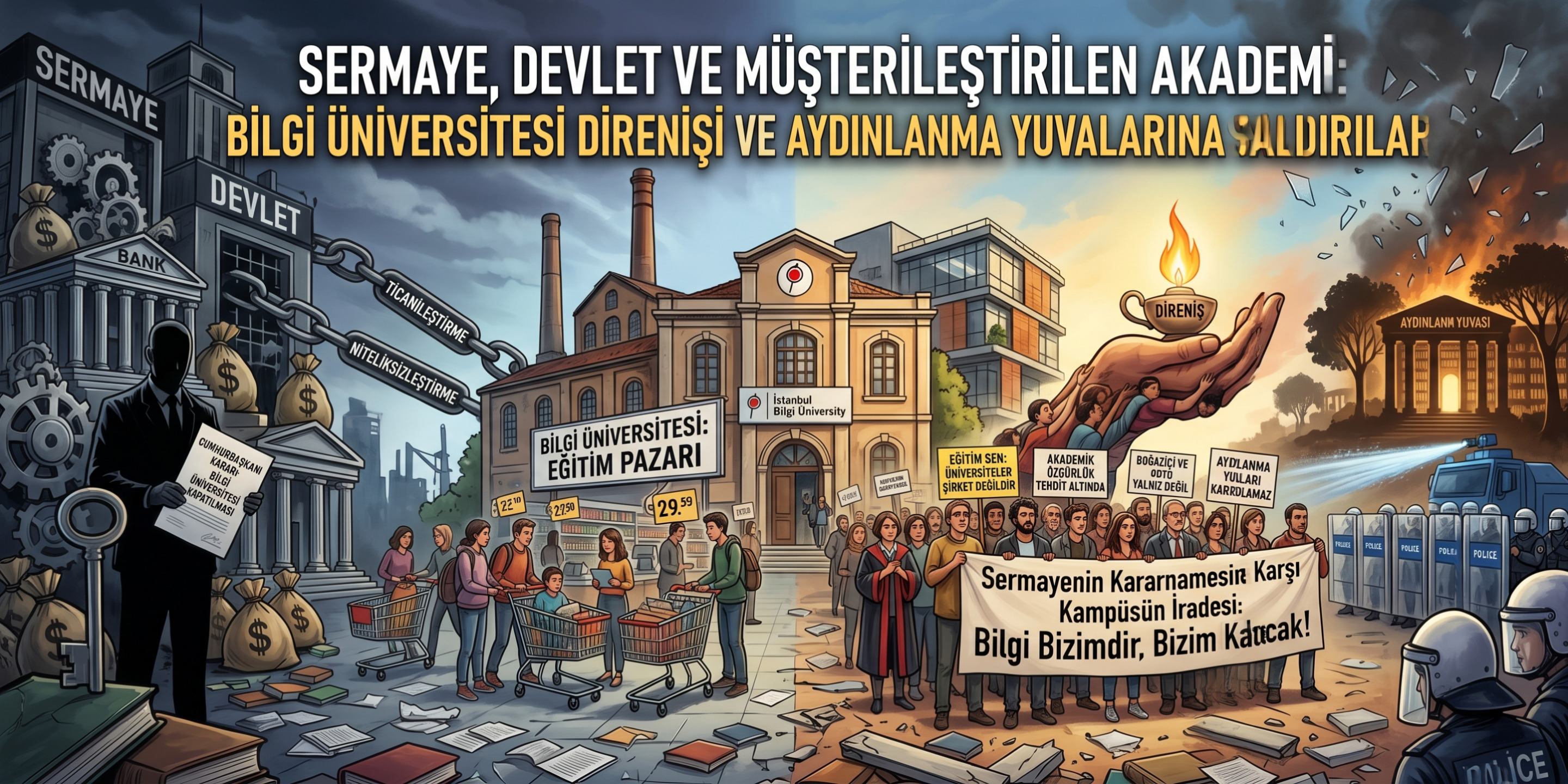
As the raging waves of neoliberal capitalism continue to swallow, one by one, the commons (the common heritage of humanity), one of the most strategic fronts of this siege is, without doubt, the academy. This mentality—which strips knowledge of its role as a dynamic that liberates knowledge and transforms the human being and society, and instead sees it as a commodity bought and sold under the savage conditions of the market, the student as a "customer," and the academic as "cheap, precarious labor"—is, in its plainest form, the project of stripping higher education of its quality.
The rupture that occurred in recent days around İstanbul Bilgi University has been a dystopian yet equally hopeful laboratory of precisely this partnership between capital and state—of how it can usurp public rights with a single signature, and of how the collective resistance that immediately rose up can repel that usurpation.
A Future Blacked Out Overnight: What Happened at Bilgi University?
The process that resulted in the closure of İstanbul Bilgi University and its reopening just three days later amounts to a structural crisis turning into a bureaucratic theater. When we look at the anatomy of the process through a sociological and legal lens, the chronology that confronts us is as follows:
- The Grip of Capital and the Trustee Process: After the university passed into the Can Holding group in 2019, a judicial investigation was launched against the holding in September 2025 on charges such as "forming a criminal organization," "money laundering," and "tax evasion." Within the scope of the investigation, the university's management structure, along with 121 companies affiliated with the holding, was seized through the TMSF (Savings Deposit Insurance Fund), and on September 12, 2025, a trustee was appointed by court order to the founding foundation.
- Usurpation by Midnight Decree: With Presidential Decree No. 11384, published in the Official Gazette dated May 22, 2026, the operating license of a university established by law was revoked overnight. This arbitrary administrative act, with a single stroke of the pen, disregarded the right to education of roughly 20,000 to 22,000 students and the job security of more than a thousand academics and administrative staff. It was announced that students would be transferred to Mimar Sinan Fine Arts University, the guarantor school, but the future of the laborers was abandoned to deep uncertainty.
- The Step Back and the Ideological U-Turn: In the face of the determined resistance carried out by students, alumni, and laborers who refused to leave the campuses, and the rising social reaction, the political power was forced to take a step back. With a new Presidential Decree published in the Official Gazette dated May 25, 2026, the closure decision was annulled, and the university reopened within 3 days.
The Regime of De-qualification and Corporatization in Education
Sociologically, foundation universities are the most concrete apparatuses of the capitalist system's policy of commercializing education. Tying a university's very existence to the financial operations of the holding to which it belongs, or to the unilateral administrative act of a single person, is proof that the academy's institutional autonomy has been entirely liquidated. As the İstanbul Bar Association rightly pointed out, the principle that "a university established by law can only be terminated by law" was violated, and legislative authority was usurped by the executive.
This mentality, which sees universities as companies opened and closed at a desk, makes the centers of scientific production dependent on rent-seeking. In this ecosystem:
- The student is reduced to the position of a "customer" who receives the service for which they have paid.
- Academics and administrative staff are subjected to precarious, flexible, and cheap labor exploitation, their contracts liable to be terminated overnight.
- Academic fields that serve social enlightenment, such as human rights, anti-discrimination, and freedom of expression, are deliberately disrupted.
A Systematic Siege Against the Nests of Light: Boğaziçi, METU, and Bilgi
This crude intervention against Bilgi University is not an isolated incident. On the contrary, it is part of the dominant ideology's strategy of marginalizing, othering, and subjugating every kind of "nest of light" that has a relatively libertarian tradition, where it has been unable to establish its own hegemony, and where critical thought has flourished.
We have clearly observed similar lines of attack in other long-established institutions in recent years as well:
In the case of Boğaziçi University, the regime of oppression and the trustee mentality established by trampling on the will of the democratic university components, most recently with the unjust and unlawful dismissal of valued academics who are its members, such as Tuna Tuğcu, aims to desertify the academy. In the case of METU, the fact that the university components, administrative staff, and workers were met with barricades and forced to march in front of the rectorate even for their most basic economic right—the updating of their bonus payments—shows how the academic field is being militarized and how the channels for democratic claims to rights are sought to be blocked.
The political power uses the processes of holding-ization and the cudgel of the judiciary as instruments in order to create within the academy a submissive, unquestioning, reactionary mass. By piling police barricades at the gates of campuses and alienating students from their own schools through identity checks, they seek to liquidate the free academic space.
Conclusion: There Is No Salvation Alone—Either All Together or None of Us!
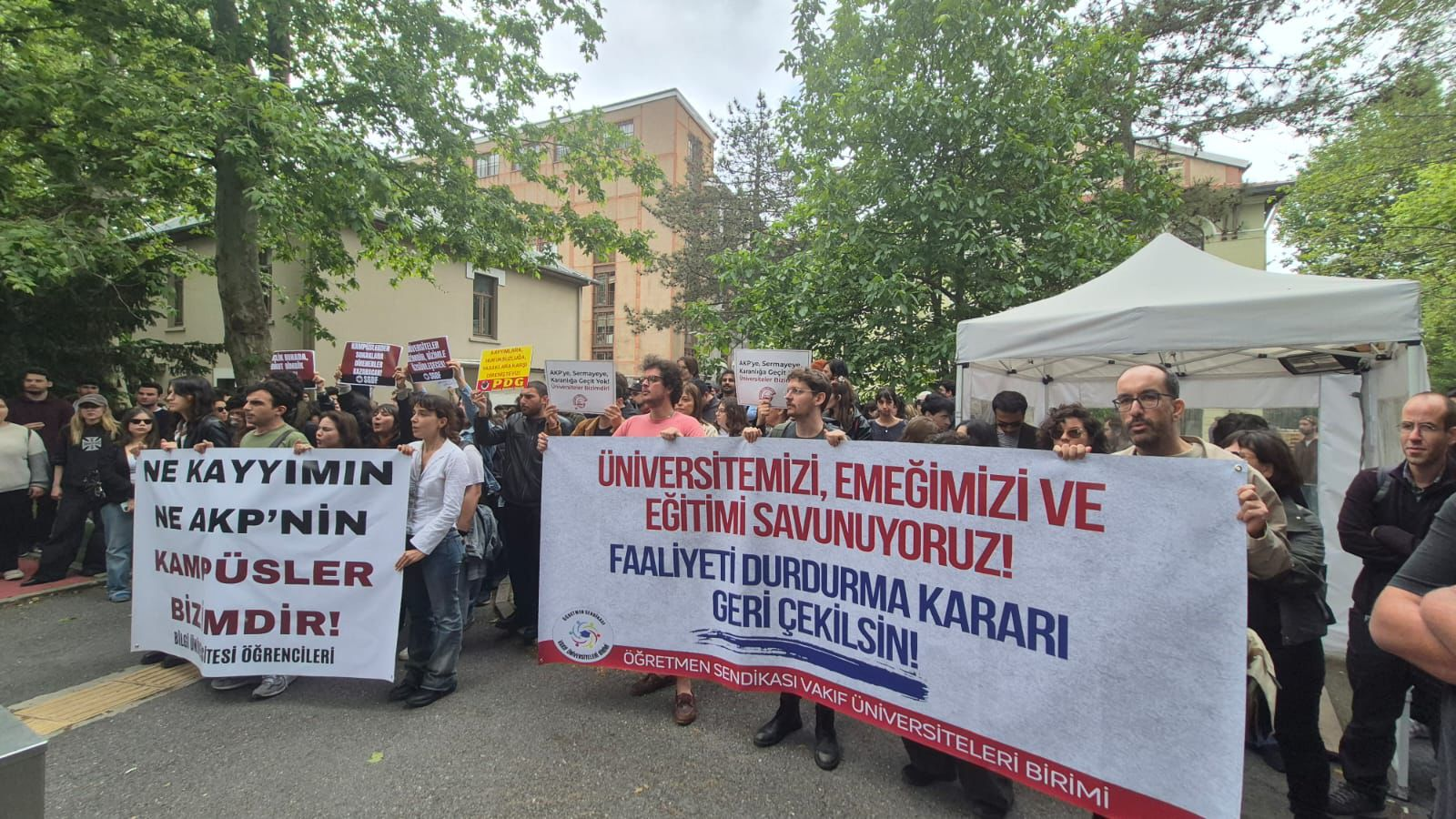
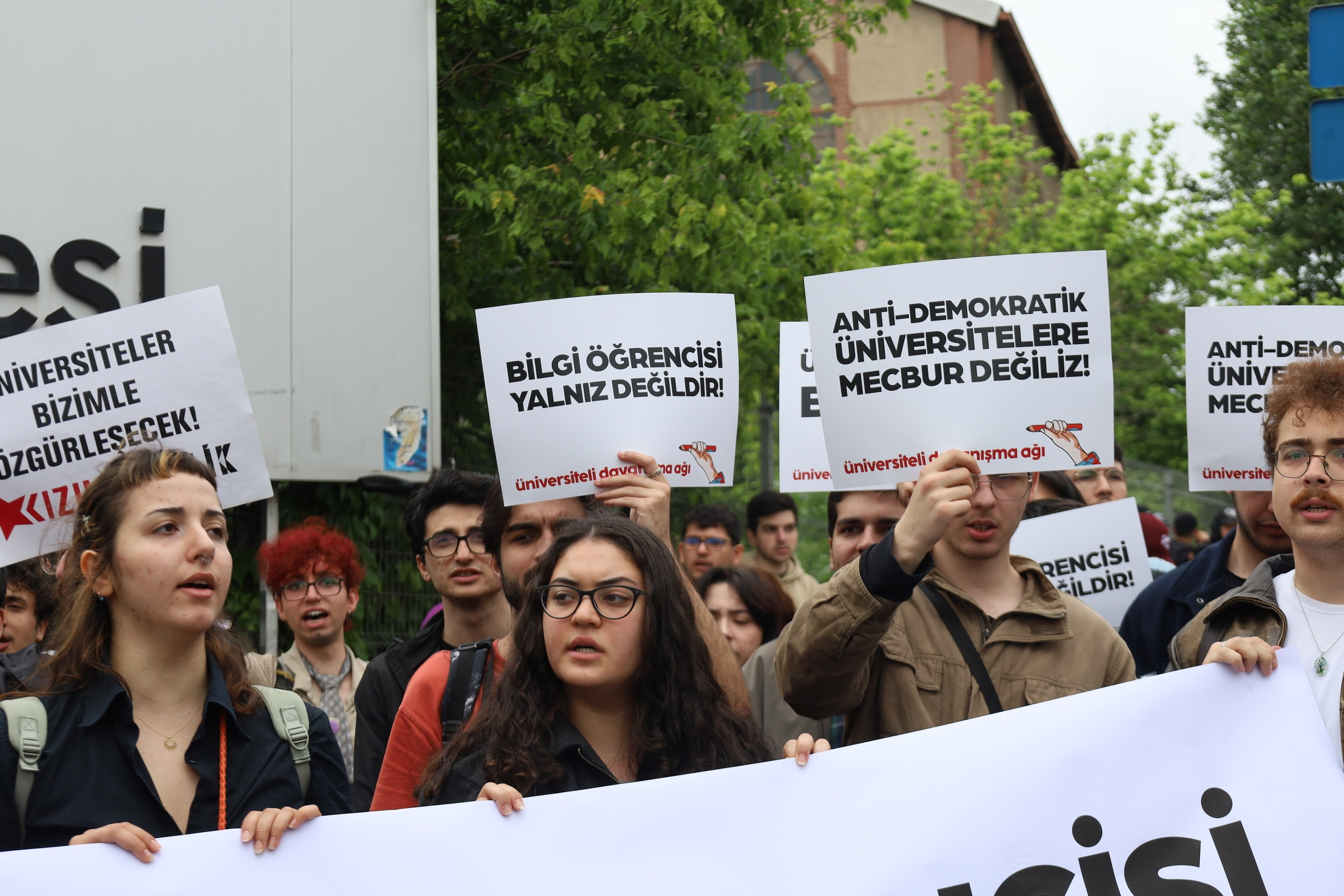
That long, nine-day resistance vigil—begun by Bilgi University students with the cry "Bilgi is ours, and ours it will remain!", in which they stood shoulder to shoulder with their alumni and professors against the police's pepper spray, plastic bullets, and barricades—has once again proven that the academy does not consist merely of buildings. What we call a university is not the profit-and-loss calculations of holding bosses or the decrees issuing from between the two lips of palaces; it is the totality of people who think, produce, debate, and stand in solidarity together.
The bombastic statements of the President of the Council of Higher Education (YÖK), such as "the process has been updated with the approval of our President," are nothing but an effort to conceal the power of the collective will that was created and of the de facto legitimate struggle. The rulers' step back is not a favor; it is a victory wrested by organized solidarity.
The right to education is not a toy, and universities are not property to be handed over to capital. The only antidote to this darkness stretching from Boğaziçi to METU, from METU to Bilgi, is to grow—on a unified line and without regard to the distinction between foundation and state universities—the struggle for the autonomous, democratic, scientific, and public university. For there is one absolute truth that philosophy and history have taught us:
Solidarity keeps us alive, organized struggle makes us win!