
Piercing the Darkness with the Mind of Labor: Organic Enlightenment and the Compass of Class
From Kıvılcımlı to Çubukçu: The Tradition of Organic Enlightenment and the Role of the Intellectual in Turkey
In the history of these lands, the concept of the "intellectual" has generally been coded as an elitist figure standing above the people, looking down on them, and offering prescriptions for "Westernization." Yet Antonio Gramsci's definition of the Organic Intellectual, which sprouted in his prison cells, shatters this template to pieces. Names such as Hikmet Kıvılcımlı, Behice Boran, Nâzım Hikmet, and Aydın Çubukçu, who emerged from within the Marxist struggle in Turkey, proved that the intellectual is not merely one who "knows," but a subject who "acts" and thinks with the nerve endings of the class to which they belong.
Piercing the Darkness with the Mind of Labor: Organic Enlightenment and the Compass of Class
Gramsci divides intellectuals into two: Traditional Intellectuals (teachers, clergy, philosophers who imagine themselves above classes and independent) and Organic Intellectuals. The organic intellectual does not merely give voice to a class's economic and political interests; they organize that class's life and grant it a cultural and moral homogeneity. The counterpart of this definition in Turkey is not those who produce theory at their desks while growing estranged from the street, but those who build the "common mind" of the class in prisons, in factories, and in magazine offices.
1. Hikmet Kıvılcımlı: The "Organic Intellectual" as a Way of Life
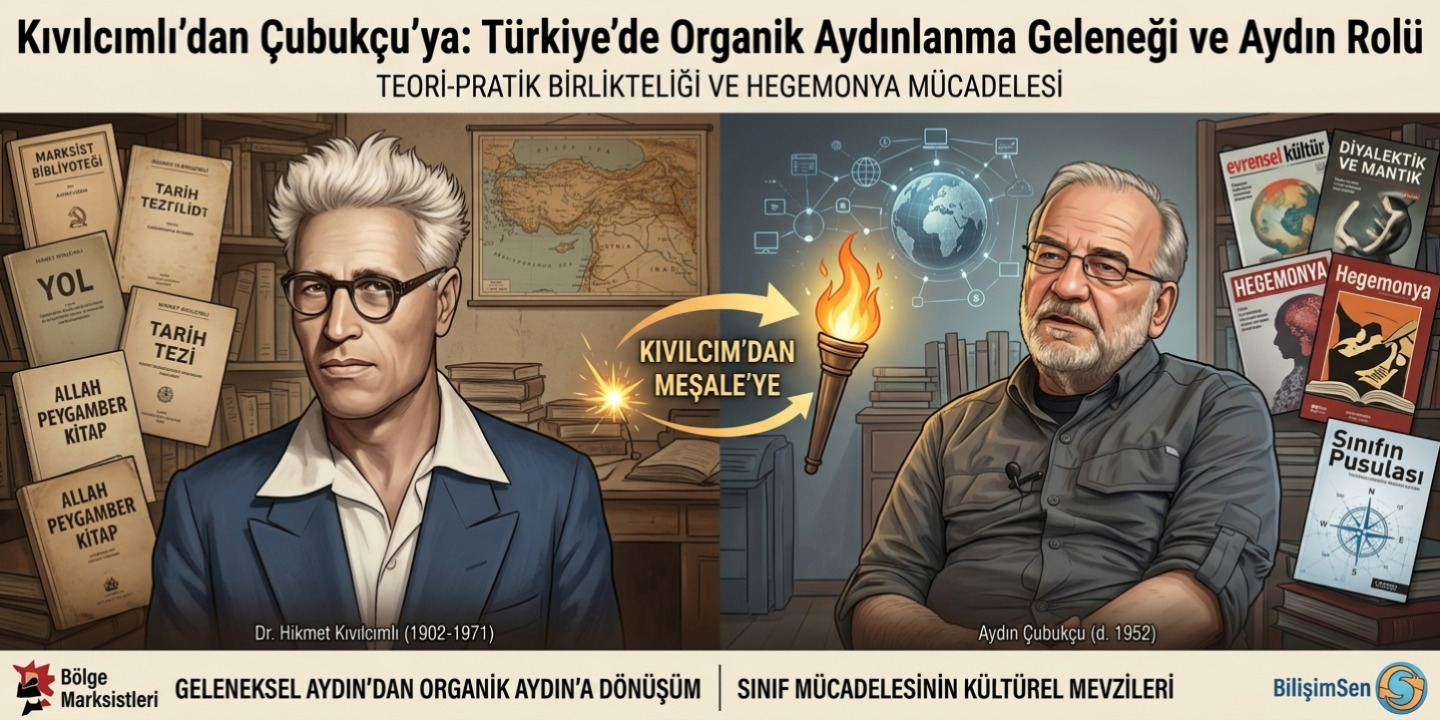
Dr. Hikmet Kıvılcımlı is one of the most original figures of the history of the Turkish left, and one of those who "paid the highest price." His characterization of the intellectual presents an architecture that blends Gramsci's theoretical framework with Turkey's concrete reality (originality).
- The Thesis on History and Social Roots: Kıvılcımlı used Marxism not merely as a translated dogma, but as a key that deciphered the genetic codes of these lands. In analyzing the feudal structure of the Ottoman Empire and the socially revolutionary roots of Islam, he grounded the consciousness of the class in a historical depth.
- The Dungeon and Production: Spending 22 years of his life in prisons, Kıvılcımlı transformed the dungeon not into an ivory tower but into a "center of production." Works such as his "Yol" (The Road) series are not merely theoretical debates but concrete guides to the class's contemporary strategy. He became not only the mind of the class, but also its most disciplined soldier.
- Speaking in the Language of the People: Kıvılcımlı was not imprisoned in academic jargon. In coffeehouses, in factories, and in courtrooms, he developed a language understood by the people, one that appealed to the conscience of this geography. For him, "enlightenment" was not transforming the people, but awakening that revolutionary essence within the people.
2. Aydın Çubukçu: A Warrior of the Cultural Trench
Aydın Çubukçu, passing through the fire of the 1968 generation, carried the role of the intellectual onto a cultural and aesthetic front. His struggle was about shaking the cultural hegemony of the rulers.
- Cultural Hegemony and Art: Çubukçu argued that the intellectual's task was not only to make economic analyses, but also to establish a focal point of aesthetic resistance. The magazine "Evrensel Kültür" (Universal Culture), which he edited for many years, is the most concrete example of how art can be turned into a weapon in the hands of the working class.
- Dialectics and Logic: His studies "Mantık ve Diyalektik" (Logic and Dialectics), penned to clarify the class's way of thinking, aim at a unity of method regarding "how the masses should think." The organic intellectual does not give the masses fish; by giving them the dialectical method of thinking, they enable the masses to create their own seas.
- Resilient Enlightenment: Against the post-1980 liberal winds and the postmodern fairy tales of classlessness, Çubukçu re-fortified the Marxist stance in the cultural field. For him, enlightenment was not a debate over secularism cut off from class, but the worldview of labor.
3. Boran and Nâzım: Organized Mind and Collective Voice
- Behice Boran: She never separated her academic depth (as one of Turkey's first female sociologists) from her partisan identity (Chair of the TİP). Boran, by defending the intellectual's disciplined presence within the "party of the class," transformed intellectual energy into a collective force.
- Nâzım Hikmet: By placing his poetry at the service of the class, Nâzım laid the foundations of a "national-popular" culture. He is the producer of organic culture Gramsci spoke of, one who synthesized the feelings and history of the people with a new worldview (socialism).
4. Today's Darkness and the Need for Organic Enlightenment
Today, Turkey and the world are passing through a period of "obscurantism" (ignorance/darkening) in which the reactionary politics of political Islam, the atomizing effect of neoliberalism, and technology turned into an instrument of oppression prevail.
How Will We Defeat the Darkness?
We can defeat this darkness not with the traditional "know-it-all" type of intellectual, but with the Organic Intellectual model represented by Kıvılcımlı and Çubukçu:
- Dissolving into the Class: Intellectuals must step out of their offices and lecterns and descend to the factories, the plaza floors, and the digital platforms.
- Building a New Language: Against the manipulative language of reactionism and populism, we are obliged to establish the genuine language of labor, science, and dialectics—a language understandable to all.
- Organizing the Technological Commons: Information workers, engineers, and data miners are the closest candidates to becoming today's "new organic intellectuals." It is this mind that will transform technology from an instrument of capital's exploitation into society's "knowledge commons."
- Uniting Enlightenment with Labor: Enlightenment is not merely standing against religious oppression; enlightenment is the human being reclaiming control over their own labor. Kıvılcımlı's "spark" must today unite with the codes of freedom written in information offices.
Conclusion: The Dawn of Homo Commonans
The future will belong not to those who grow wealthy on their own, but to those who integrate their knowledge and their labor with the cause of their class. The historical perseverance of Hikmet Kıvılcımlı, the organized discipline of Behice Boran, and the cultural depth of Aydın Çubukçu show us the way.
The force that will defeat the darkness is the new generation of enlightenment pioneers—those who not only read but also organize, and who forge organic bonds with their class in the very heart of life. This path will free us from the shackles of property and carry us to the freedom of the commons, that is, to Homo Commonans.
Light does not come only from above; light is born from the converging mind of those below!
BilişimSen: The Mind of Labor, the Light of the Future.
"If a class needs an intellectual, that class must create its own intellectual from within itself, through its own struggle." – Inspired by Gramsci.