

The Wage, Price, and Profit Process for the IT Worker
Content
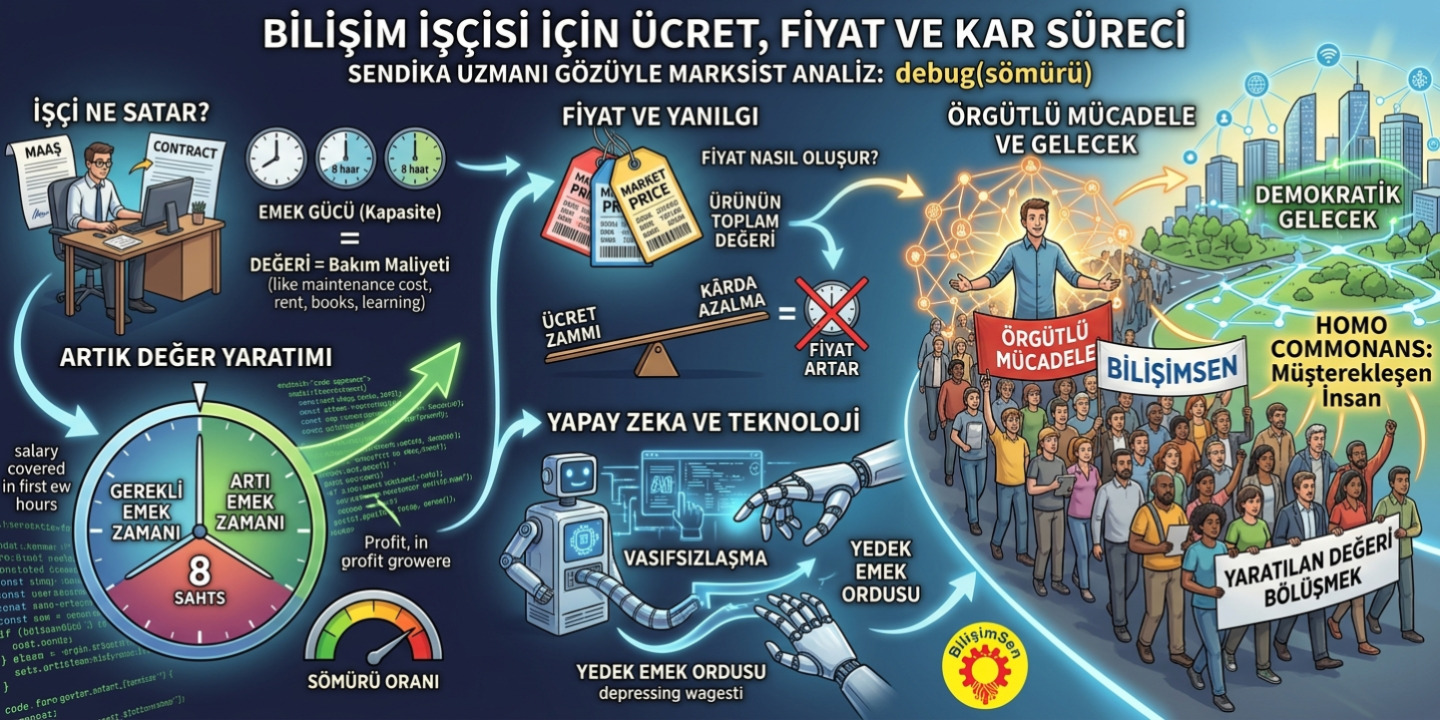
Hello, my senior friend, welcome. Grab your coffee, sit down at the table. Today we are going to set aside those fancy titles, the promises of "equity," and the "we are a family" slogans, and talk about the real mathematics of the money in our pockets and of our labor.
When Karl Marx delivered his Wage, Labour and Capital address in 1865, across from him sat a citizen (Citizen Weston) who said, "If wages rise, prices rise, so there's no point in demanding a raise." Today, across from us, there is a boss class saying, "That's just how the market is, there's competition, programmers already earn plenty."
Come, let's "debug" Marx's lessons from that day for you, through the eyes of a BilişimSen specialist.
1. What Are We Selling? Labor, or Labor Power?
When the boss tells you, "I'm paying you for the code you write," it's a huge lie. You don't get paid in exchange for code.
- Labor Power: For 8 hours, you are selling your capacity to solve problems, build algorithms, and keep systems running.
- Its Value: Your wage (the value of your labor power) is the cost required for you to be able to sit back down at that desk the next day: it is the "maintenance cost" needed to pay your rent, eat healthily, buy books/courses to learn new technologies, and rest a little.
2. Surplus Value: Your "Voluntary" But Unpaid Overtime
Marx's greatest discovery is this: the workday is divided into two.
- Necessary Labor Time: Within a sprint, it is the time during which you earn back your own wage and the office expenses. In IT, this usually ends within the first day or two of the week.
- Surplus Labor Time: All the rest of the time! Those wonderful features you write and the databases you optimize are in fact the unpaid labor written into the company's profit column.
In short: The company can sell the software you write for 1 million dollars, but it pays you only the "market rate" wage. The difference between them is not your "gift"; it is the surplus value they have appropriated.
3. If Wages Rise, Do Prices Rise? (Weston's Fallacy)
The bosses say: "If we give you a raise, we'll have to increase the price of the product, and that will cause inflation." To this, Marx says, "Come off it!"
- Inverse Proportion: Wages and profits are two parts of total value. If one rises, the other falls.
- The Reality: When you get a raise, subscription fees or SaaS prices don't automatically go up. It just means the model of the luxury car the boss will buy that year goes down a notch, or the shareholders' dividend drops slightly. The fight is the fight over whose pocket the created value will go into.
4. Technology and Deskilling (Code-Writing Machines)
Marx describes how machines are turned into the worker's rival. Today, artificial intelligence (AI) and "low-code" platforms are exactly this.
- Technology is used not to liberate us, but to create a "reserve army of workers" that can take our place.
- When they teach your skill (your knowledge) to a machine, they try to drive down the "value of your labor power." Because now they suppress wages with the illusion that "anyone can write code."
5. The Solution: Why Is Union Struggle Essential?
Marx says: capital must constantly expand and must capture labor ever more cheaply. This is its nature. If you say to yourself, "I'm a great programmer, nothing will happen to me," capital will toss you aside at the first economic crisis (or at the first successful AI model).
- The Wage Level: It is not determined solely by supply and demand. Where the wage settles depends on the power relationship between worker and boss.
- Resistance: If you are not organized, your wage stays at the lower limit "just enough to survive." If you are organized (like with BilişimSen), you wrest from that enormous created surplus value what is rightfully yours (shorter working hours, greater welfare).
Specialist's Note: A Call to the IT Worker
My senior friend; whatever your title may be, if you are not an "equity" holder or an owner of the means of production (the servers, the property), then you too are a worker. What Marx said 150 years ago is still valid today on your Jira board:
"The emancipation of the workers must be the act of the workers themselves."
While writing code, connect not only with machines but also with your class siblings. Because no matter how complex the algorithm gets, the mathematics of exploitation always stays the same.