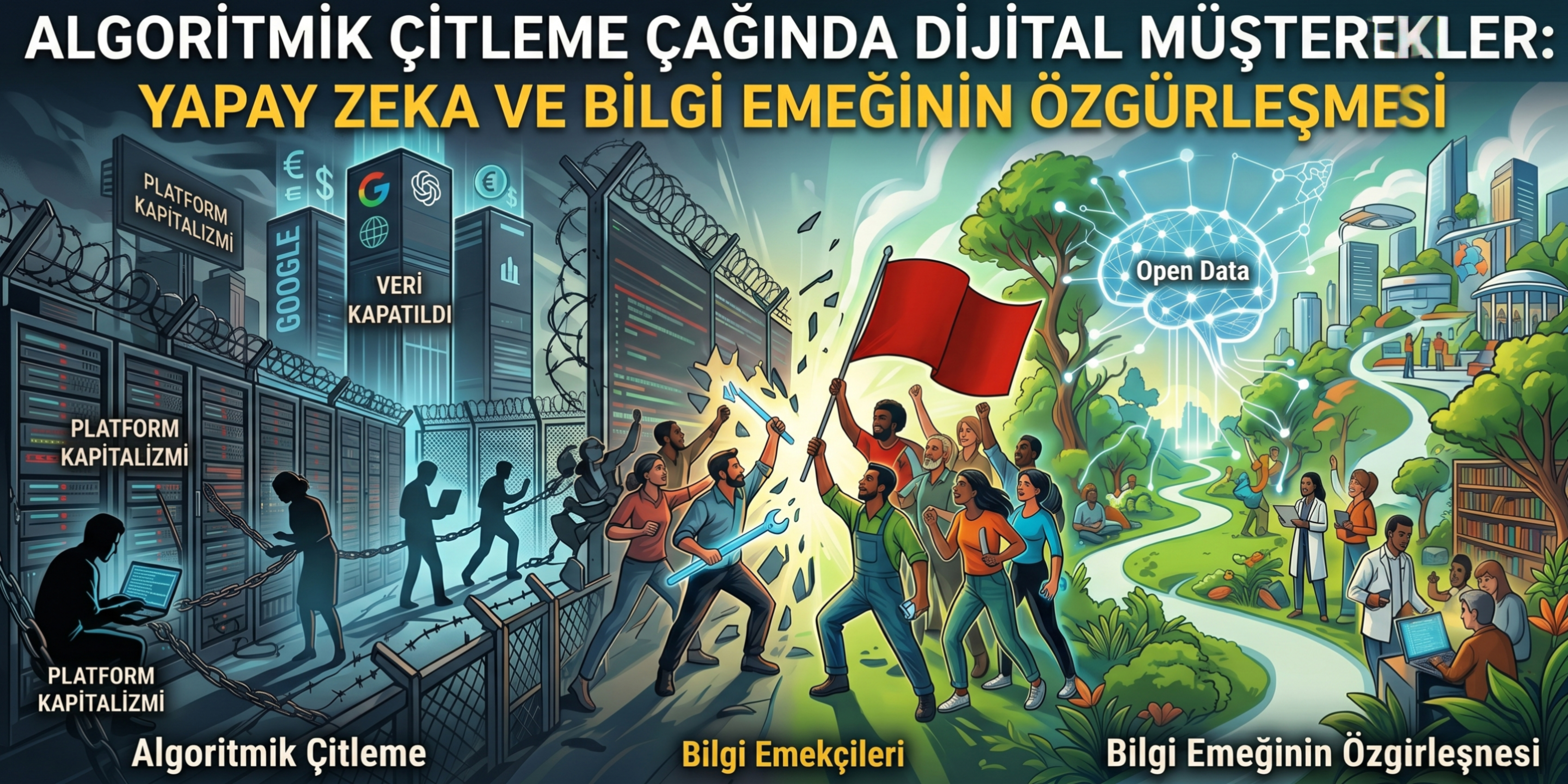
A Class Algorithm Against Technofeudalism: The Global Struggle of IT Workers
Concrete Gains Around the World, Rights Awareness, and the Future of Organized Power
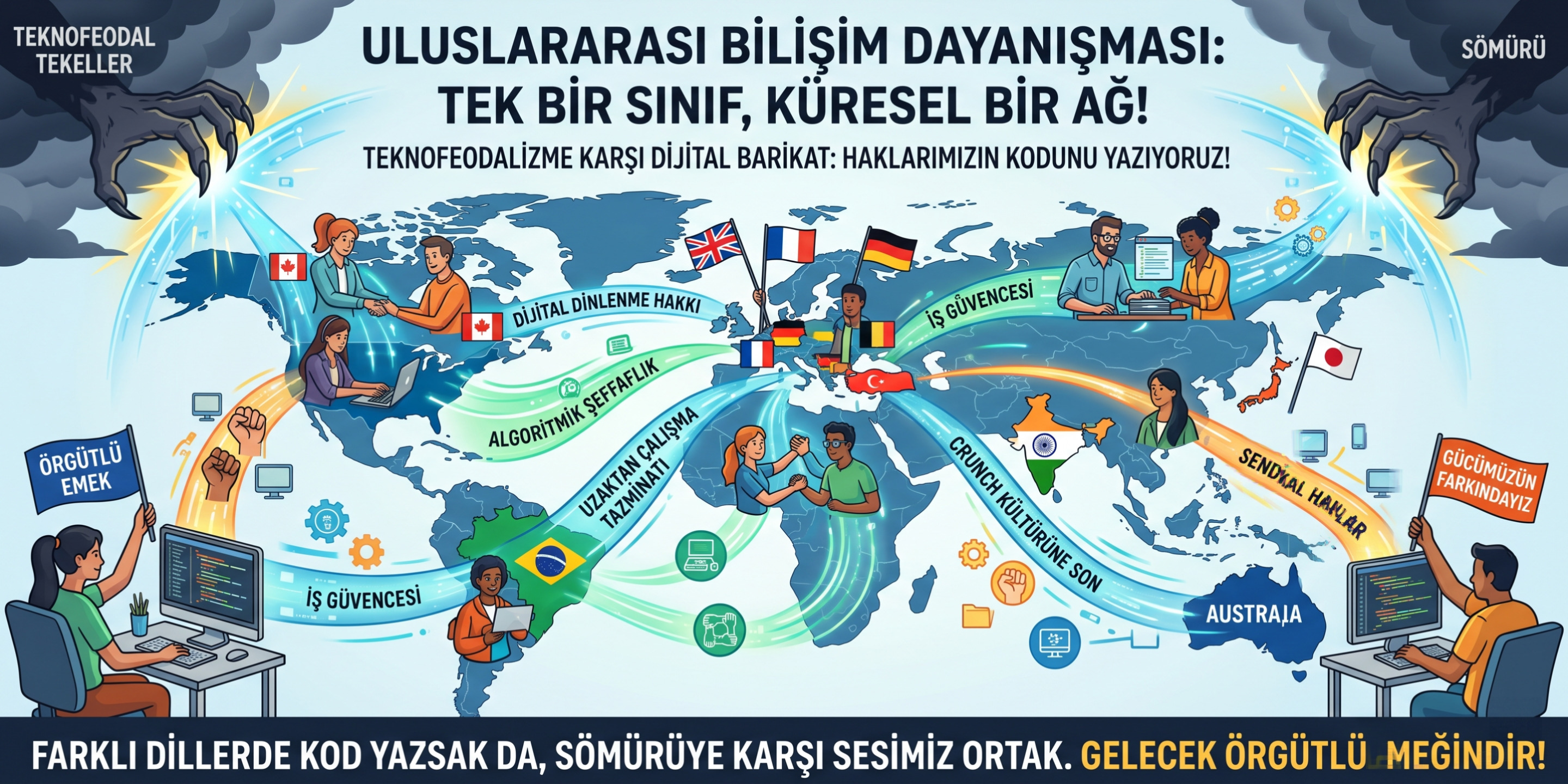
The technofeudal forms of exploitation born in Silicon Valley and now spreading across the globe are uniting IT workers beyond national borders into a single "global factory." As software engineers, data analysts, AI data labelers, and system administrators, we may speak different languages, but we are all crushed within the same cloud infrastructures, under the same mechanisms of algorithmic oppression. The only possible response to this global encirclement is an internationalist front that transcends borders and local cliques and is grounded in concrete gains in rights.
We who work in IT, design, gaming, and technology are being turned into the "digital serfs" of this digital ecosystem. Yet against this dark picture, IT workers are rising up all over the world, rewriting the code with solidarity.
The Epic Battles Won Against the Tech Giants
For many years, big tech companies blocked unionization by hiding behind the myth of "flexible work," "colorful offices," and "free individuals." But as exploitation deepened, resistance became inevitable.
The Legend of the Amazon Labor Union (ALU): > Workers at the JFK8 warehouse in New York managed, for the first time in history, to establish an official union against Amazon's union-busting funds with their billion-dollar budgets and armies of professional lawyers. This victory became a spark that proved to the entire world that technofeudalism is not invincible.
Alphabet Workers Union (AWU-CWA) and Google Workers: > Founded within Alphabet, Google's parent company, this union grew solidarity by covering not only full-time engineers but also the subcontracted workers who shoulder the system's real burden, the AI data labelers (AI raters), and contract personnel. With campaigns such as "Googlers for Job Security," they are erecting a global barrier against arbitrary layoffs carried out under the pretext of artificial intelligence.
A Country-by-Country Guide to IT and Technology Organizations
We are not alone in this struggle that crosses borders. In different parts of the world we have sister organizations and unions that suffer from the same troubles and fight for the same goals:
| Country / Region | Organization / Union Name | Focus and Field of Struggle | Official Link |
|---|---|---|---|
| USA | Alphabet Workers Union (AWU-CWA) | Security for Google employees and subcontracted AI workers, and the struggle against workplace discrimination. | alphabetworkersunion.org |
| USA | CODE-CWA | An umbrella movement organizing game developers, software workers, and digital-sector employees across the United States. | code-cwa.org |
| UK | United Tech and Allied Workers (UTAW) | A CWU-affiliated national branch covering all trades in the tech industry, data analysts, and tech-focused couriers. | utaw.tech |
| UK | Prospect Union (Tech Workers) | AI ethics, protection of digital rights, data privacy, and smart working conditions against burnout. | prospect.org.uk |
| Germany | ver.di (ICT Sector) | Collective bargaining and the reduction of weekly working hours through works councils (Betriebsrat) at giants like SAP and IBM. | verdi.de |
| France | Solidaires Informatique | Securing overtime pay, fighting mobbing, and protecting union rights specifically in the gaming and IT sector (Ubisoft, etc.). | solidairesinformatique.org |
| Australia | Professionals Australia | Setting fair wages and sectoral standards for Australian engineers and IT specialists. | professionalsaustralia.org.au |
| Global | UNI Global Union - Alpha Global | An international coalition of Google workers that brings together technology unions worldwide. | uniglobalunion.org |
Our fundamental task today is not merely to wage an inward-looking battle over bylaws; it is to bring these progressive gains from around the world into our own country's labor law and actual workplace practices. We must add the following rights to the agenda of our common front:
- The Right to Disconnect: We will write into all contracts in our country the right—already enshrined in law in Europe—not to answer emails, Slack messages, or WhatsApp messages that arrive outside working hours.
- AI and Algorithmic Transparency Guarantees: We will demand international standards against having our performance scored by AI or hidden algorithms, and against being eliminated by metrics that violate human dignity.
- Secure Remote Work: In line with universal norms, we will guarantee that the internet, electricity, equipment, and food expenses of those who work from home or in hybrid arrangements are fully covered by the employer.
Country by Country: Rights Won and Centers of Resistance in the Technology Sector
IT unions and grassroots organizations around the world long ago shattered the myth that "software workers don't unionize." Here are the concrete rights won through fierce, tooth-and-nail struggle, country by country:
France: The Conviction of "Crunch" Culture and the Guarantee of Rest
Solidaires Informatique, organized in France's gaming and IT sector, brought down through the courts the culture of "Crunch" (the intensely demanding, unpaid overtime that lasts for weeks during project delivery periods), technofeudalism's biggest weapon. As a result of lawsuits filed against global gaming giants like Ubisoft and Don't Nod:
- Retroactive Collection of Overtime: All the hidden overtime workers had worked over the previous three years was collected from the bosses with interest, with Slack and email records accepted as evidence.
- The 35-Hour Limit: Companies were subjected to heavy administrative fines for exceeding the 35-hour weekly working time as tracked by digital monitoring tools.
Australia: The Ban on After-Hours Communication
As a result of the long lobbying and grassroots actions of Professionals Australia, which represents technology and engineering workers in Australia, the "Right to Disconnect" was enacted into law. Under this expanded law:
- Block on Calls and Messages: Employers were legally prevented from reaching workers via email, Slack, or WhatsApp outside working hours.
- Penal Sanctions: Companies that, without justifiable cause, disturb their employees during rest hours began to be hit with heavy fines amounting to tens of thousands of dollars.
Belgium: Work-From-Home Compensation Through Collective Agreements
As a result of union pressure from IT workers in Belgium, the right to disconnect and remote-work standards were included in collective bargaining agreements (CBAs) at all private-sector companies with more than 20 employees.
- Mandatory Material Infrastructure: It was made compulsory to pay every IT worker who works from home a fixed monthly "remote-work allowance" for internet, electricity, and ergonomic office equipment (chair, monitor, etc.).
USA: Union Protection for Subcontracted and AI Workers
Organized in the heart of Silicon Valley, the Alphabet Workers Union (AWU-CWA) struck a blow against Google's greatest hypocrisy, the "TVC" (Temporary, Vendor, Contractor) system.
- Equal Pay for Equal Work: Through the struggle they waged under the union's umbrella, AI data labelers (AI Raters) and subcontracted software workers gained the same minimum wage floor and health coverage as permanent staff.
- NLRB Victories: Production workers at Netflix Animation Studios and remote workers at DreamWorks officially unionized by holding votes before the National Labor Relations Board (NLRB), and won protective clauses against AI threatening their job security.
Data and Legal Comparison: Turkey vs. the World
Seeing the legal gaps to which IT workers in our country are exposed and the gulf between us and international standards will form the foundation of the bylaws and program of struggle we will defend at our first general assembly.
| Rights Category | Current Situation in Turkey (Labor Law No. 4857) | World Practice (Example Countries) | Our Union Objective |
|---|---|---|---|
| The Right to Disconnect | Not defined in law. Under the name of "flexible work," 24/7 pressure via Slack, WhatsApp, and email is legal. | France, Portugal, Australia: After-hours communication is banned. Violations result in heavy fines for the company. | To write into the CBA that access to digital systems is cut off outside working hours, or that any such access counts as overtime at a 200% multiplier. |
| Remote-Work Expenses | Although the regulation states "the employer covers it," there is no oversight or sanction. The burden of electricity, internet, and equipment falls on the worker. | Belgium, Germany: Companies are required to pay a fixed monthly work-from-home allowance or to provide a tax-deductible infrastructure budget. | To ensure the addition of internet, electricity, and depreciation costs to net pay as an "IT Infrastructure Allowance." |
| Algorithmic Oversight & AI Guarantees | At the boss's discretion. Arbitrary layoffs under the pretext of performance, justified by AI tools, are widespread. | EU (AI Act) & Germany: Software that monitors workers (taskmetrics, etc.) cannot be installed without the approval of the works council (Betriebsrat). | To open all performance-measuring algorithms to union oversight, and to enshrine that AI tools cannot serve as grounds for dismissal. |
| Weekly Working Time & "Crunch" | The legal weekly limit is 45 hours. But actual work in IT is 60+ hours, and overtime is mostly unpaid. | France (35 Hours), UK (UTAW Victories): Work over the set hours is recorded in writing and can be collected retroactively. | To reduce weekly working time to a net 35 hours, to ban "Crunch" periods entirely, and to have overtime tracked by the union. |
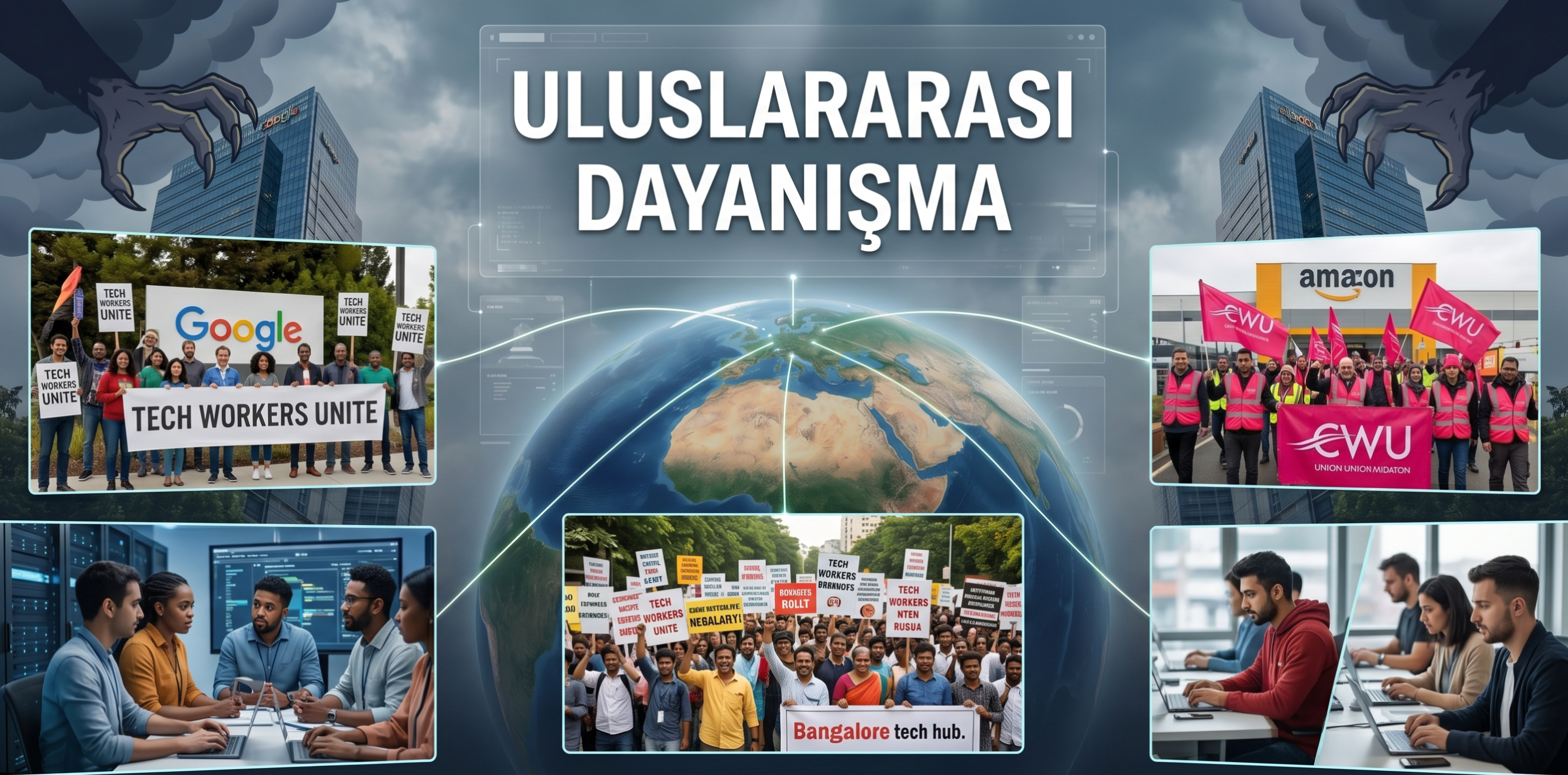
A Common Front: The "International Hack" That Transcends Borders and Cliques
While the technofeudal monopolies confronting us act with a common strategy at the global level, for us to remain trapped inside petty delegate calculations, personal careerist quarrels, or narrow factional bureaucracies is to betray this class. What a true union expert and a class-conscious member should look at is not the balance of cliques, but the coordinates of the global front of struggle.
International coalitions like Alpha Global, founded within UNI Global Union, show us the roadmap for common struggle. To expand this front and make it the backbone of our local struggle, we must take these three strategic steps:
A) Cross-Border Repository Solidarity
When a global technology company or outsourcing firm lays off IT workers engaged in union activity in any country, or seizes their rights, IT unions in other countries must step in. The common front means that, on a project where software workers in one country have gone on strike, software workers in another country refuse to push code to that repository or to perform system updates. We will lock down global exploitation with global work slowdowns and digital solidarity actions.
B) Global Legal and Rights Integration
We will make the digital-rights and living-wage criteria published by the European Trade Union Confederation (ETUC) and the ILO (International Labour Organization) in 2025/2026 the inviolable clauses of the first collective bargaining drafts we produce locally. While the internal cliques raise bureaucratic obstacles asking "what does the current Labor Law permit," we will impose the progressive gains of international labor law on workplaces through actual struggle.
C) Internal Union Democracy and the Principle of Transparent Code
The first condition of integrating into the global common front is to clean our own house. Anti-democratic practices within the union and the secret meetings of factional cliques are contrary to the nature of IT workers. In our union, we defend a model of digital direct democracy in which decisions are as transparent as open-source software, open to every member's vote and oversight, and which permits no delegate-bossism.
Conclusion: Rights Awareness Among Those Who Run the Global Infrastructure, and Building an Organized Future
We are not desperate, isolated individuals flailing about merely to pay the end-of-month bills, to make rent, or to play the role of the "happy worker" in the glittering corridors of techno-parks and plazas. We are the architects of the digital infrastructure that weaves the networks connecting the world from end to end and that keeps the modern world standing—from finance systems to the health sector, from production lines to logistics chains. In short, we are the true source, the engine, and the creative subject of the system. We know very well how, when we lift our fingers from the keyboard, when the cloud systems fall silent and the servers are unplugged, the global machinery freezes within seconds. In the 21st century, to halt production is not merely to flip the switch of a single factory; it is to send a global "stop" command to the center of technofeudalism. Becoming aware of this immense power and of our central role in production is the first and greatest step toward changing the future.
The greatest illusion we face as IT workers is the belief that the burnout we experience, the endless overtime, and the precarity are "natural rules" of this sector. Yet examples from around the world clearly show us that having our lives stolen under the name of flexible work, or being shown the door under the pretext of AI, is not an inevitable fate but merely a systemic error—a bug. To become aware of our rights is to see the "Right to Disconnect," the "Algorithmic Transparency Guarantee," and the "Remote-Work Allowance"—which our colleagues from Paris to New York wrenched away inch by inch—as indispensable standards of our own future too. Every software worker, designer, or system administrator who is fragile alone before the boss becomes the most powerful actor in the system the moment they are armed with a global awareness of their rights.
We Will Write the Code of the Future with Organized Power Against the global technology monopolies that cross borders, individual struggles for survival waged alone lead us only to greater burnout. The solution is to be aware of our rights at a global level, to integrate the progressive gains of the world into our own working lives, and to build a pool of organized power on the side of labor. When one of us has their rights violated, we must build that organized power through which the entire sector rises up with a common reflex and a digital network of solidarity.
The way to throw that heavy nightmare of Monday mornings and that familiar knot in the stomach on Sunday evenings into the dustbin of history lies not in individual escape plans, but in this collective barricade where all IT workers stand shoulder to shoulder with an awareness of their rights. We may write code in different languages, we may sweat at different companies, but the color of the exploitation we endure—and the potential of the organized power we will build against it—are shared. When all the technology and IT workers of the world become aware of their own power and come together, the colossal servers of technofeudalism will fall idle one by one; and that free future in which labor is not alienated, in which production is not torture but joy, and in which every day is lived with the cheer of a Sunday, will begin in our own hands.
We are coming not merely to run the system, but to reprogram it—through our organized power—according to human values.
The future is ours, labor is ours!