
Deciphering the Political Simulation: Fallacy Logic and the Democratic Mind
A Guide to the Democratic Mind and Critical Thinking Through the Example of "Absolute Nullity"

Introduction: The Critical Importance of Fallacy Analysis Within Democratic Culture
Modern political communication is not merely an arena where concrete data or manipulated facts compete; the real war is fought over modes of reasoning and logical foundations. The greatest threat democratic societies face is no longer merely plain disinformation, but the fallacies skillfully hidden within arguments. Fallacies are mental illusions that at first glance appear rational, legal, and entirely reasonable, but which—when deconstructed—contain deep logical errors and distortions of intent.
The analysis and exposure of fallacies in a society is of vital importance for the following reasons:
- Rescuing Truth from the Simulation: Fallacies, by placing an artificial reality (a simulation) before the masses, cover over real problems, usurpations of authority, and constitutional violations.
- Protecting the Freedom of Organization and Expression: Mechanisms that wish to domesticate opposition centers or narrow the space for civilian politics to maneuver usually wrap their arguments in moral or legal fallacies. A society whose mental filter is open tears off this wrapping and notices the rights violations at the very first moment.
- An Anti-Manipulation Immune System: Citizens being able to recognize logical errors in political rhetoric develops a collective immune system against moves that deepen social polarization.
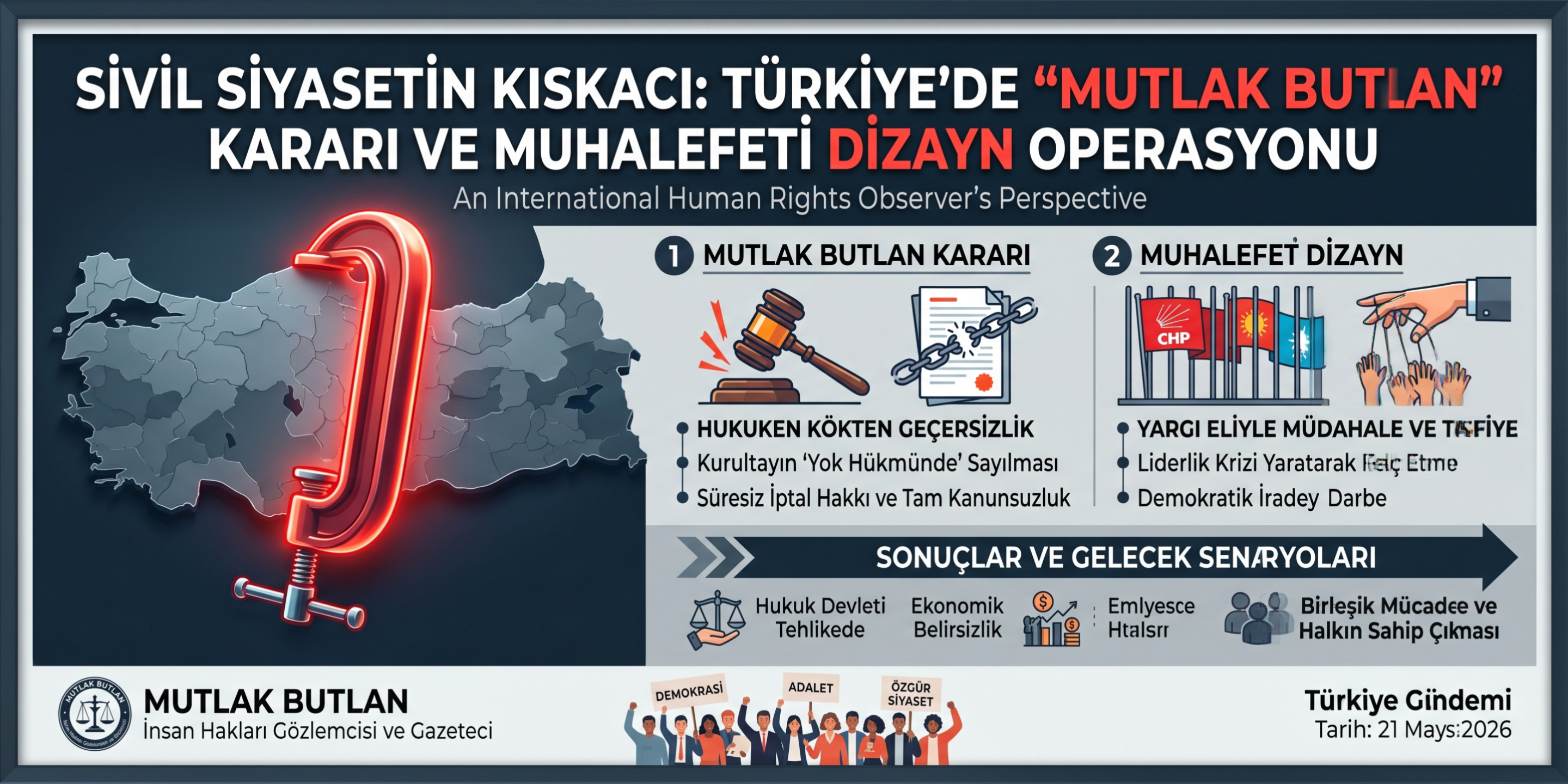
In this article, through the "Absolute Nullity" ruling of May 21, 2026—an unprecedented turning point in Turkey's political and legal history—we will examine, with concrete examples, which fallacy bugs (vulnerabilities) the sovereign power and the status quo resort to in order to manipulate public opinion, and we will address methods of thinking correctly.
Thinking Methods and Correct Analysis Approaches
In order not to be swept up in the wave of disinformation during periods of political and legal crisis, we must actively use certain methodologies that the science of logic and critical thought offer us. The fundamental analysis approaches that will enable us to reach the correct conclusion in complex, constitutional-crisis-generating processes such as "Absolute Nullity" are as follows:
1. First Principles Thinking
This is the method of, when solving a problem or evaluating a claim, setting aside the layers produced afterward and the interpretations of lower courts, and descending to the system's most fundamental, unshakable truths.
- Application: When examining a judicial ruling placed before us, instead of getting stuck on the court of first instance's interpretation of the Civil Code, we look at the founding text of the system. In the constitutional order of the Republic of Turkey, the supervision and certification of elections fall exclusively within the authority of the Supreme Board of Elections (SBE) under Article 79 of the Constitution, and these decisions are final. This is the fundamental principle. Every lower interpretation that tramples this principle is eliminated in a first-principles analysis.
2. Distinguishing Causality from Correlation (Causality vs. Correlation)
Two events occurring one after another, or there being a relationship between them, does not prove that one is the absolute cause of the other.
- Application: The relationship between a former party leader publishing a "purification"-themed video and the court announcing a precautionary ruling changing the administration the next day cannot be explained by a simple "functioning of the legal process" correlation. An analysis that does not take into account the political motivations in the background (the snap-election plan, the desire to paralyze the first-party opposition) errs by mistaking correlation for causation.
3. The Necessity and Sufficiency Test
This is to test whether the grounds put forward for a claim to be considered legally or morally valid are both necessary and sufficient to produce that result.
- Application: The existence of allegations of irregularity at the delegate level in a political party's convention is a matter for the criminal judiciary. But the existence of these allegations cannot be a sufficient legal ground for a civil court of first instance to bypass the constitutional electoral regime and wholesale disregard the convention will of an entire party.
Political Fallacies Through the 2026 "Absolute Nullity" Case
The process by which the 36th Civil Chamber of the Ankara Regional Court of Justice annulled the CHP's 38th Ordinary Convention and all subsequent convention decisions, removing the current administration from office as a precautionary measure, was served to the public with numerous logical fallacies. Let us decipher these fallacies with their concrete examples:
| Fallacy Type | Its Reflection in Politics / Example Argument | Establishing the Truth / What Is Really Happening? |
|---|---|---|
| The Appeal to Legality Fallacy (Appeal to Legality) | "Just as in civil law a marriage performed by an unauthorized person is tainted by absolute nullity, so the convention is legally deemed never to have been held. This is a technical rule of law." | A constitutional-hierarchy trick has been played by treating political parties as having the status of associations. Annulling finalized election results through the ordinary judiciary is to effectively disregard the SBE, a constitutional institution. |
| The Straw Man Fallacy (Strawman) | In Justice Minister Akın Gürlek's account: "This ruling is the rule of law standing tall against the elements casting a shadow over the will, and democracy protecting itself." | The intervention was made not to protect democracy, but to domesticate a constitutional structure that became the first party with 38% of the vote in the last elections, by drowning it in internal disputes. |
| False Dilemma (False Dilemma) | "There's cash distributed in suitcases, job promises. You'll either accept this immorality or you'll respectfully welcome the court's purification ruling that returned the trustee administration." | Society is being forced into a false dilemma between "consenting to an unlawful civil coup" and "defending corruption." The real option is to protect the will of the ballot box and the constitutional limits while fairly trying the irregularity allegations in a criminal court. |
| The False Cause Fallacy (Post Hoc Ergo Propter Hoc) | "The ruling coming out on the eve of the holiday break is entirely a natural consequence of the independent working calendar of the judicial bodies." | The timing was strategically arranged to dampen the social civil resistance, and to dissolve—over the 9-day holiday—the pressure of the Central Bank's billions of dollars in foreign-currency sales and the stock-market shock. |
A Detailed Analysis of the Fallacies in the Case
1. The Mask of Legal Legality (Category Error and False Analogy)
In the suit filed by former Hatay Metropolitan Mayor Lütfü Savaş and his colleagues, the concept of "Absolute Nullity" was bolted onto political law in order to expand the ordinary judiciary's sphere of authority. This link, established by giving civil-law examples such as a marriage performed by an unauthorized person, is a false analogy. The convention wills of political parties and the credentials they receive are not an ordinary association's general assembly, but a constitutional part of the electoral-law regime. The court, by hiding behind a technical concept, tried to cover up the fact that it had trampled the domain of a constitutional organ (the SBE).
2. Presenting the Effort to Create "His Majesty's Opposition" as "Purification"
That actors close to the old administration are publishing "purification in the party" manifestos and consenting to take the seat by judicial power is being presented to the public as a "legal victory." The fundamental reasoning error here is to deem an entirely null a party's democratically changed will, on the basis of allegations not yet certified by criminal proceedings. As Özgür Özel also cried out in the squares:
"We reject the comfortable, cushy, eternal opposition seats offered to us. We reject being His Majesty's opposition!"
A model of administration regulated through the palace judiciary is constructed not to morally cleanse the party, but to keep under control the risks before the ruling bloc (the pending Supreme Court trials, the parliamentary arithmetic).
3. The "Market Intervention" and Liberal Fatalism Fallacy
As economy writers and academics (for example, Ümit Akçay) have noted, the thesis that arises against the ruling power's authoritarian steps—"The markets won't allow this; an economic crisis will make the ruling power back off immediately"—is also a liberal fatalism fallacy. What is really happening is this: the ruling power, while engineering the political arena, tries to effectively subsidize the resulting financial shock (Borsa Istanbul's circuit breaker, capital flight, the rise in CDS) by burning 6 billion dollars of reserves from public banks in half an hour. That is, the fallacy claims that "the market does not punish the political with its invisible hand"; on the contrary, the enormous bill for these unlawful operations is loaded onto the citizen's back as the high cost of living.
How Should We Take a Stance Against Fallacies for a Democratic Culture?
At this historical threshold, where the political arena is being engineered in courthouse corridors using judicial apparatuses, in order to rebuild democratic culture and protect our rights, we must take the following clear stances against fallacies:
- Operating the "Who Benefits?" (Cui Bono) Principle in Discourse Analysis: We must look not at the technical reflections of the argument placed before us, but at the political result it creates. If a ruling that paralyzes the founding elements of multi-party life is being characterized from the outside as "democratic protection," then we must bring rational reason into play there and hold onto the unshakable principle that "what comes by the ballot box goes only by the ballot box."
- Not Allowing Words and Institutions to Be Bent: Against forced interpretations such as "Absolute Nullity" that, under the guise of law, disregard the people's votes and certified credentials, we must not abandon our linguistic and legal positions. We must say out loud that a civil court of first instance cannot bind the will of millions.
- Taking as Our Basis Not Personal and Institutional Buildings, but the "Free Will": What brings political parties into being is not institutional buildings, seals, or Treasury taps; it is the free will put forth by the voters. With this awareness, when the gap between officialdom and de facto legitimacy widens, we must take our place alongside legitimacy and the voice of the street.
- Growing the "United Front" Solidarity: The most effective antidote against the sovereign power's moves to divide and fragment the opposition is for all components—from the furthest right to the furthest left—to form a hierarchy-free Democracy Front with the awareness that "what is done to my neighbor today will be done to me tomorrow." By rejecting the artificial debates the fallacy creates, we must take a peaceful and determined mass stance on the ground of constitutional rights and civil disobedience.
Turkey's future will be determined not by scenarios of authoritarian consolidation or by time-calibrated judicial rulings that came out of the palace's typewriter, but by the organized resistance of the people, who themselves defend—without yielding—their own rights, their ballot box, and their reason. Weeding out fallacies is the greatest mental ammunition of this resistance.
You might be interested ...
https://paragraph.com/@bilisimsen/simulasyonun-safsata-buglarini-ayiklama-kilavuzu