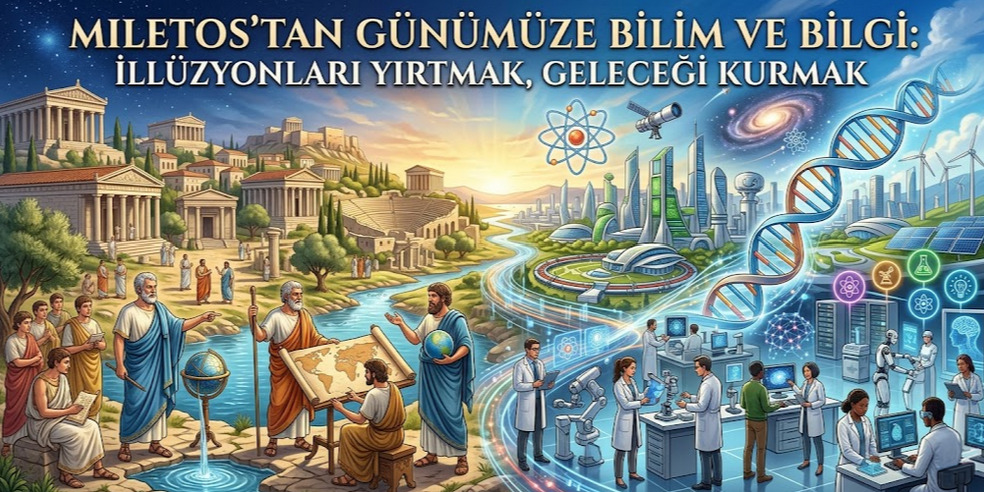
Philosophy from Miletus to the Present: Tearing the Illusions, Building the Future
Hearing the Logos at the Temple of Apollo: The Universal Call of Truth
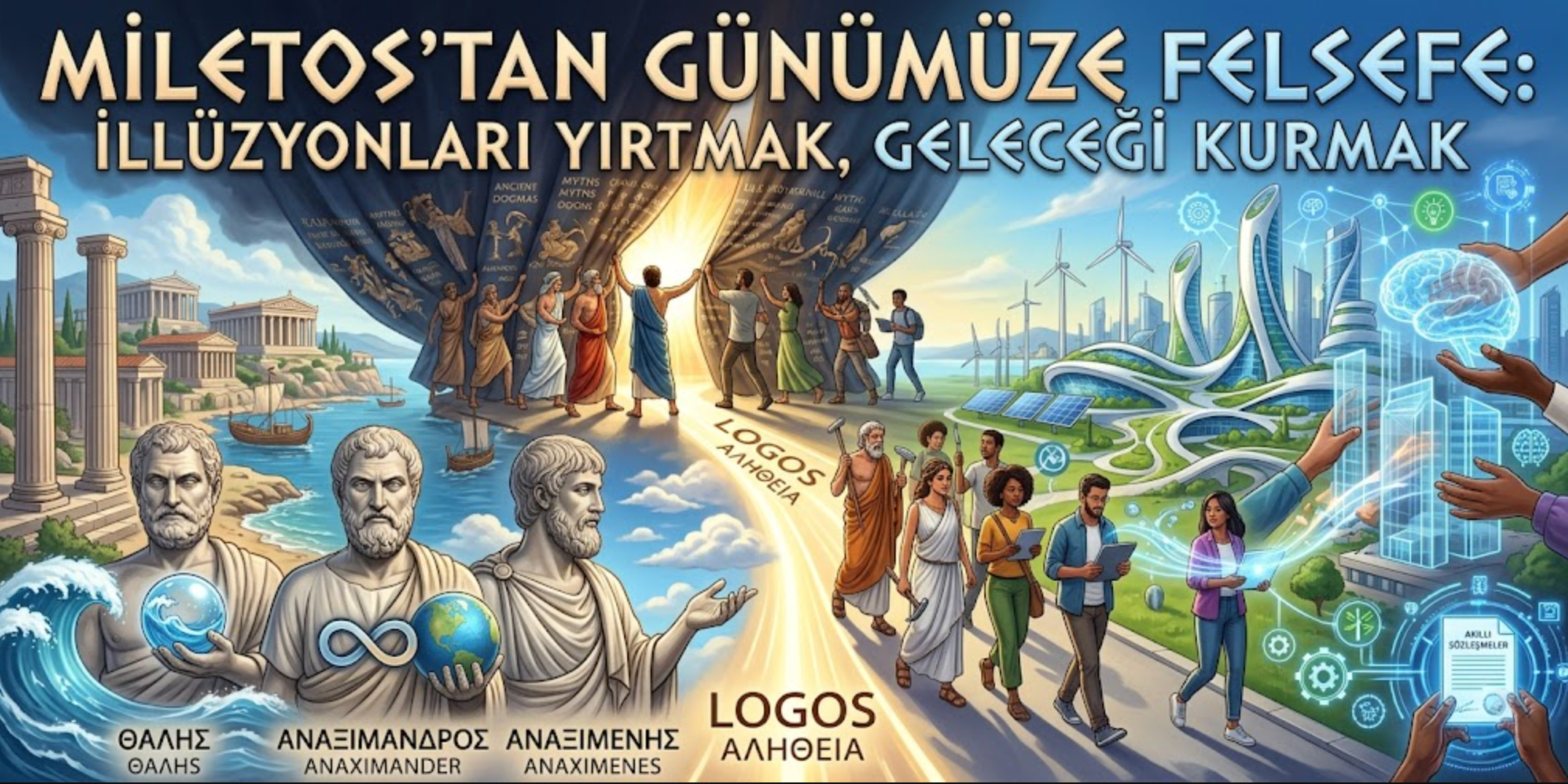
On these lands where the waters of the Aegean break upon the ancient shores of Miletus, the "Philosophy from Miletus to the Present" event, hosted by the Municipality of Didim, is not merely an intellectual luxury or a cultural activity that yearns for the past. Viewed through an epistemological lens, this gathering is a stage on which humanity remembers, grasps anew, and tears apart the illusions of the dominant ideology—recalling that first great radical step it took from the darkness of mythos (legends/dogmas) toward the light of logos (reason/material reality). Philosophy is a lever that rescues the world from celestial explanations and brings it down to earth, that is, to its material foundations; and Miletus is the place where this lever was first set up.
Ethics and Politics from Miletus to Today: Birth, Rupture, and the Reality of Class
Forming one of the most vital threads of the event, the heading "Ethics and Politics from Miletus to Today" brings us face to face with the harshest dialectical contradiction in the history of philosophy. Today, "ethics" and "politics" appear as two concepts entirely insulated from one another—indeed, set against each other as enemies—yet on those first lands where philosophy was born, they were bound together like flesh and nail.
The Vital Importance of the Miletian Period: The Unity of Logos and the Polis
The attempt of the Miletian school (Thales, Anaximander, Anaximenes) to explain nature not through the arbitrary decrees of the gods but through the material rules within it (Arkhe) inevitably triggered a new consciousness regarding the order of human society as well. If there was a rational order in the universe, a Logos, then there had to be a rational and just order in the city built by humans (Polis) too.
In the Miletian period, the relationship between ethics and politics was an objective necessity:
- Ethics was the science of how the individual should live rightly and virtuously within the community.
- Politics was the practice of building the social and spatial common ground on which this virtuous life would be made concrete.
In that era, politics was not the art of managing a conglomerate in the hands of a professional caste, as it is today; it was the activity of organizing the common life of citizens, of seeking justice and the common good. Knowledge (episteme) and action (praxis) had not yet been divorced from one another.
Ethics and Politics Today: The Misery of Bourgeois Politics
When we look at the plane of bourgeois politics produced by the capitalist superstructure today, we see a complete epistemic rupture and moral collapse. In the political arena, ethics is nothing more than an ornamental word used in election manifestos or a hypocritical rhetoric deployed to wear down rivals.
As Karl Marx pointed out, while capitalist relations of production commodify everything, they have also turned politics into a "market" where professional politicians buy and sell, manipulating the masses through mechanisms of manufacturing consent.
Politics Is Too Important to Be Left to Politicians
Today's bourgeois politician is a technocrat who guards the interests of the ruling class and paralyzes the consciousness of the masses. As Lenin brilliantly analyzed in The State and Revolution, bourgeois democracy offers the masses the freedom to choose, once every few years, which clique of the ruling class will oppress them.
But the truth is this: Politics is too vital a matter to be surrendered to politicians. For politics is a material practice that determines every second of our lives—from the working hours of the laborer in the factory to the price of the bread on our table, from the cleanliness of the air we breathe to the security of our future. Either we will produce politics over our own lives, or we will be the objects of a professional caste that decides on our behalf.
The Praxis of the Future: Smart Contracts, Algorithmic Reason, and Technological Participation
The way to overcome that shallow ethics-politics rupture of bourgeois politics is not to deliver mere moral sermons or to busy ourselves with ballot-box arithmetic. The solution lies hidden in the dialectical potential of the material infrastructure—that is, in the historical stage reached by the productive forces. When we look back today from the world of 2026, the line stretching from that first primitive materialist reason of Miletus to the decentralized networks of the digital world is, in fact, the technological moment in humanity's struggle to take its own destiny into its own hands.
Smart Contracts, blockchain architecture, and decentralized autonomous organizations (DAO) promise, on the philosophical plane, a destructive cyber-praxis that shakes to its roots the epistemological legitimacy of the bourgeois state apparatus and its caste of professional politicians.
The Dialectic of the Productive Forces and the "General Intellect" (Social Collective Intelligence)
In that prophetic section of the Grundrisse known as the "Fragment on Machines," Karl Marx said that in the maturing phase of capitalism, science and social knowledge would become a direct productive force, and he called this the "General Intellect" (Social Collective Intelligence). According to Marx, capital appropriates this collective intelligence in order to further alienate and exploit the worker; yet this technological infrastructure is at the same time capitalism's own gravedigger.
Today, blockchain and smart contracts are this General Intellect having taken on a concrete, objective, and digital body.
- The Objectification of Property: In capitalist relations of production, "trust" and "contract" are an apparatus of oppression in the hands of bourgeois law—that is, of the courts, notaries, and state bureaucracy monopolized by the ruling class.
- The Power of Code: Smart contracts, on the other hand, take law and rules away from the monopoly of the rulers and transform them into transparent, mathematical, and open-source code. The contract is no longer an ideological text open to the rulers' interpretation; it becomes an objective social practice that directly reflects the will of the parties.
Epistemological Transparency and the Withering Away of Bureaucracy
In The State and Revolution, Lenin develops Friedrich Engels's famous thesis: with the transition to socialism, the state—that is, the function of "governing people"—will wither away and give way to "the administration of things and the management of processes of production." In Lenin's vision, this means a simplification of the state mechanism so radical that any literate worker (or, in his famous analogy, "every cook") could take part in the administration of the state, keep statistics, and exercise oversight.
This is precisely where smart contracts and blockchain serve as the technological lever for this Leninist moment of "simplification" and "withering away":
The bourgeois politician is a parasitic "intermediary" standing between the masses and the decision-making mechanisms. He hides information, manipulates, and manufactures consent. Blockchain architecture, by its very nature, eliminates intermediaries.
Decision-making processes (for example, where a budget will be spent, how social resources will be distributed) are determined through smart contracts by direct, unmanipulable, and transparent voting. On this plane, there is no longer any room for the "lying politician," "backroom diplomacy," or "campaign promises." A decision is made, the code is triggered, and material reality is built instantly. This is the tearing apart of the ideological fog over knowledge and decision—that is, complete epistemological transparency.
A Bogdanovian Horizon: Tectology and Algorithmic Planning
Let us recall Alexander Bogdanov, one of the most brilliant and equally tragic figures of the early Soviet period, Lenin's chief rival in the philosophical field. In his work Tectology: The Universal Science of Organization and in his science-fiction novel Red Star, Bogdanov imagined the future socialist society as a system governed by an immense network of statistics and computers (mechanical calculators, given the conditions of the time), in which all production and decisions were coordinated by a decentralized council of computers.
Bogdanov's tectological vision, which seemed utopian at the time, is today turning into a scientific reality through smart contracts. Contemporary digital materialism shows us that algorithms, just as in the hands of capitalism they can become exploitative "digital stewards" (like the algorithms of Uber and Amazon) that surveil the worker all day long, can in the hands of collective reason also be transformed into a "Cyber-Soviet" apparatus that instantly analyzes social needs, plans production, and operates direct participatory democracy.
Cyber-Praxis and Overcoming Alienation
In modern philosophy, the analyses by the French philosopher of technology Gilbert Simondon on "the mode of existence of technical objects" are of vital importance. Simondon argues that the cause of humanity's alienation from technology is not technology itself, but its structure, which enslaves the human within capitalist relations of property. The technological object is a tool that rationalizes the bond the human establishes with nature and society.
A new technological participation rising on the foundation of smart contracts is the birth of cyber-praxis:
- The Word Becoming Action: In traditional bourgeois politics there is an unbridgeable abyss between the word (theory) and the deed (practice); the politician makes promises but does not keep them. In the smart contract, however, the word (the code) is, by its nature, action. If X, then Y (If condition X is met, execute Y). This is, in the philosophical sense, a flawless dialectical union of theory and empirical reality.
- Participatory Ontology: The masses will no longer be mere objects of the system as "voters" once every few years; in the network of smart contracts they become active constituent subjects who at every moment submit proposals, update the code, and build social life in real time.
Miletus's attempt to grasp nature through reason has today evolved into the will to govern technology through collective reason. To wrench smart contracts away from the bourgeoisie's instruments of financial speculation (the crypto-gambling market) and turn them into a direct instrument of the sovereignty of the masses is the greatest philosophical and political struggle of praxis in the coming century.
Beautifying Life in the Light of Miletus: The Epistemic Leap and Aesthetic Praxis
To commemorate Miletus today in Didim does not mean sanctifying a dusty heritage frozen in the linear flow of historical time, or taking refuge in an aristocratic intellectual nostalgia. To understand it means to objectively grasp that our present conditions of alienation, the ideological illusions besieging us, and those "end of history" fairy tales sprinkled over us are not destinies. For an epistemologist, Miletus is the first great revolutionary leap that human consciousness made toward "reality-in-itself" by breaking the chains of the dominant religious/mythological hegemony.
To beautify life is precisely this aesthetic and political moment where theoretical awakening meets practice (praxis). To deepen this moment with the cornerstones of materialist philosophy and epistemology will also shed light on our present struggle.
From Epistemic Reflection to Creative Praxis: Lenin and Spinoza
Bourgeois philosophy conceives of understanding and beautifying the world as an object of passive contemplation. Yet philosophy is not the passive mirroring of the world, but the absorption of the objective laws that will transform it.
In those immense notes of the Philosophical Notebooks he took on Hegel's Science of Logic, Lenin formulates this constitutive and transformative power of consciousness with dialectical-materialist clarity:
"Man's consciousness not only reflects the objective world, but creates it... The world does not satisfy man and man decides to change it by his activity."
When Thales rescued the world from the arbitrary wrath of mythological monsters and Olympian gods and surrendered it to the measurable and comprehensible material universe of reason, he was in fact giving back to humanity the power (the potential) to change the world.
This brings us to Baruch Spinoza's great epistemic revolution. In the Ethics, Spinoza says that what will free man from sorrowful affects (from passivity, from becoming a subject) is to be rid of "inadequate ideas" and to attain "adequate ideas" (objective knowledge). The inadequate idea is the illusions produced by bourgeois politics; the adequate idea is the knowledge of class reality. According to Spinoza, objective knowledge increases man's potentia agendi (power to act). To beautify life, then, is to shake off the darkness of sorrowful passions and ignorance, and to rise up with the constitutive joy and the power to act that rational knowledge provides.
Material Aesthetics: "The Beautiful Is Life"
Nikolay Chernyshevsky, one of the greatest sources from which Lenin and the Russian revolutionary democrats drew philosophically, in his work The Aesthetic Relations of Art to Reality demolishes bourgeois idealism's concept of "pure beauty" and writes the manifesto of materialist aesthetics:
"The beautiful is life; beautiful is that life in which we see things as they ought to be."
This thesis of Chernyshevsky's also became the founding philosophy of Soviet literature and socialist realism. The philosophical seed sown in Miletus is precisely the attempt to place life itself at the center of philosophy and aesthetics.
To beautify life is not to imprison it in abstract galleries, elitist philosophy congresses, or the tourism bulletins of bourgeois municipalities; it is to create the material conditions under which those who produce life (the working class, the oppressed) can themselves reproduce their own existence in an aesthetic and just manner. In Maxim Gorky's immortal novel Mother, the expression of enlightenment that appears on the workers' faces as they discuss philosophy and politics in their secret meetings is precisely the moment when the logos filtering down from Miletus merges with class consciousness. In Gorky's words, what beautifies the human being and life is the consciousness of "ceasing to be the object of history and becoming its subject."
The Epistemology of the "Not-Yet": Ernst Bloch and Concrete Utopia
Ernst Bloch, one of the most original names in modern Marxist philosophy, who recast epistemology through the concept of hope, speaks in his masterpiece The Principle of Hope (Das Prinzip Hoffnung) of the capacity of human consciousness to grasp not only what exists but also "what is tendentially appearing on the horizon." Bloch calls this Noch-Nicht-Gewordene (the Not-Yet-Become) and Noch-Nicht-Bewusst (the Not-Yet-Conscious).
The Miletian School, through its natural philosophy, had opened before humanity the door of a "Not-Yet" world, of a rational future. Looked at from Bloch's perspective, to discuss Miletian philosophy today in Didim is not a static archaeological study belonging to the past, but a design of a concrete utopia belonging to the future. Epistemology becomes revolutionary the moment it refuses to be imprisoned within the limits of the status quo.
"Hope is grounded in the objective-real tendency of the world. It is not merely a wish; it is the consciousness of seeing the cracks within material reality and organizing, here and now, the future that will seep through from there." — Ernst Bloch
Conclusion: A Salute to the Praxis of the Future
To sum up, comrades: that first materialist cry begun by Thales with water (Arkhe), broadened by Anaximander with the infinite (Apeiron), flows in the same river as Marx's destructive call to action in the Theses on Feuerbach, Lenin's uncompromising theoretical line defending objective reality, and Bloch's ontology of hope that sees the future from today.
There is only one way to beautify our life today under the light of Miletus: to pass these shallow bourgeois illusions, the lies of the media, and the false theatrics of politicians through an epistemological filter and reject them. To arm ourselves with the unshakable knowledge of truth, and—combining that knowledge with the possibilities of technology, science, and collective reason—to organize that audacity, that praxis, which will radically change life. This philosophical line stretching from Miletus to the present is the most deeply rooted dawn of the theoretical consciousness that will build the free and classless world of the future.
You might also be interested in...