Beyond the Black Mirror, the Great Refactor: From Dystopia's Objection to the Epic Construction of a Collective Dawn
The Great Compilation Age of a Humanity That Refuses Submission
**WARNING: CONTAINS MAJOR SPOILERS! **
Speculative Fiction as a Cognitive Vaccine and the Illusion of the Mirror
At no period in history has humanity nurtured as deep an anxiety, as paralyzing a cynicism, and as strong a sense of submission toward the future as it does today. On the plane of the twenty-first century—where technology rises at geometric speed while human and social relations regress with arithmetic clumsiness—the future is now coded not as the place of liberation, but of an absolute enslavement. Lodged precisely at the very center of this dark subconscious, Black Mirror carries a meaning far beyond any popular-culture commodity in the history of television. This universe Charlie Brooker has constructed is not a death-prophet whispering an inevitable end to humanity; on the contrary, it is a cognitive vaccine that makes us immune against the wild waves of the future.
The traditional dystopian canon (1984, Brave New World, Fahrenheit 451) depicts massive totalitarian Leviathans that envelop the human being from head to toe, see everything, and render objection impossible. The modern person who reads these works is crushed before the magnitude of the system and sinks into a passive helplessness. This is precisely the point of Black Mirror's immense radical deviation from that traditional line: the show shows us not a dictatorship descending from the sky, but how the very devices we buy with our own hands—for our comfort, our passion for speed, and our loneliness—turn into dungeons. The tragedy here stems not from technology itself, but from the absence of public oversight, legal barricades, and a collective will that watches over the good of humanity.
This article, and the future fiction that will rise from it, has been written to declare how watching Black Mirror and similar speculative dystopias will transform us into more resilient, alert, and militant founding subjects in the face of the future. Deciphering the darkness in the mirror is the first condition for breaking that mirror and building a commons-based world in its place.
The Great Exposure – The Regulatory and Class Anatomy of Black Mirror Episodes
Each episode of Black Mirror is a forensic report showing how capital and unregulated technology exploit the human essence piece by piece. The show's most praiseworthy achievement is exposing the "ethical and legal void" (the regulatory void) behind this exploitation.
A. Nosedive and The Entire History of You: The Corporatization of the Public Sphere and Privacy
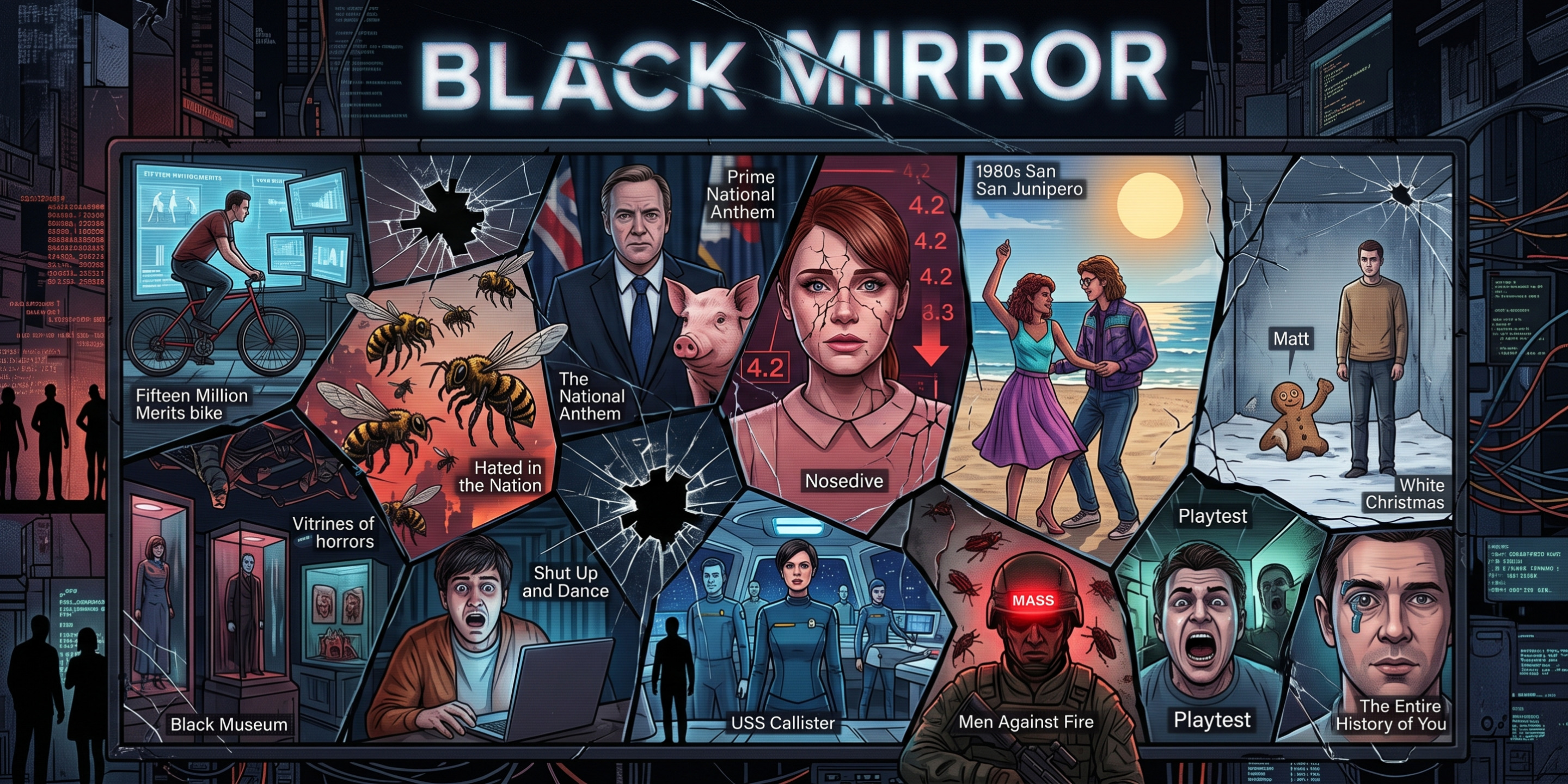
- The Nosedive episode tells of a caste system in which people rate one another out of 5, and based on these ratings can rent homes, board planes, and gain social status. This fiction shows how technology can become totalitarian not as a punishment mechanism, but as a "manufacture of consent" and a mechanism of social approval. What the episode exposes is the financialization of social relations. A profile management devoid of public oversight makes the human the guard of their own narcissism.
- The Entire History of You, on the other hand, is built on an implant placed behind the eye that records every second lived and allows it to be rewound and watched. When this technology is not supervised within the framework of property relations, it strips away the human's most basic right—the capacity to "forget and forgive." A memory technology whose legal limits have not been drawn, in the name of security and absolute transparency, turns marriages, friendships, and individual psychology into interrogation rooms.
B. Fifteen Million Merits and Joan Is Awful: The Enclosure of Labor and Identity
- Fifteen Million Merits places before us a working class (a "cybertariat") that earns virtual points by pedaling until morning in rooms covered with massive screens, and spends these points to buy clothes for their digital avatars or to enter talent competitions. This episode shows how capitalism fully colonizes leisure and play space through "mental Taylorism." If technology is used not to reduce working hours but to produce new forms of exploitation, then there is no regulation there, but the absolute dominion of capital.
- Joan Is Awful, on the other hand, is a modern nightmare in which quantum computers and CGI technology can turn an ordinary person's life into a TV series within seconds, without their consent. The episode exposes the extent to which corporate plunder—hidden behind digital identity rights and user agreements (terms and conditions)—can reach. The human's ownership over their own face, name, and life story is stripped away through unsupervised contracts.
C. Hated in the Nation and Metalhead: The Savagery of Technology That Is Not Fail-Safe
- Hated in the Nation deals with how artificial bees—produced to imitate nature after ecological collapse—are seized by a hacker and turned into micro-assassination weapons that kill people lynched on social media. This episode exposes the global security crisis that would be created by the failure to bind autonomous systems and AI infrastructures to a strict "fail-safe" protocol (switching to safe mode when the system crashes) by states and independent public auditors.
- Metalhead, on the other hand, is the terror created in a dehumanized world by autonomous robot dogs that have had no moral coding done and run solely on the command "hunt and destroy." This is the ultimate result of the war industry and the military-industrial complex taking AI out of human oversight (human-in-the-loop).
The Digital Labyrinths of the Wild Market – Technofeudalism and Anti-People Dystopias
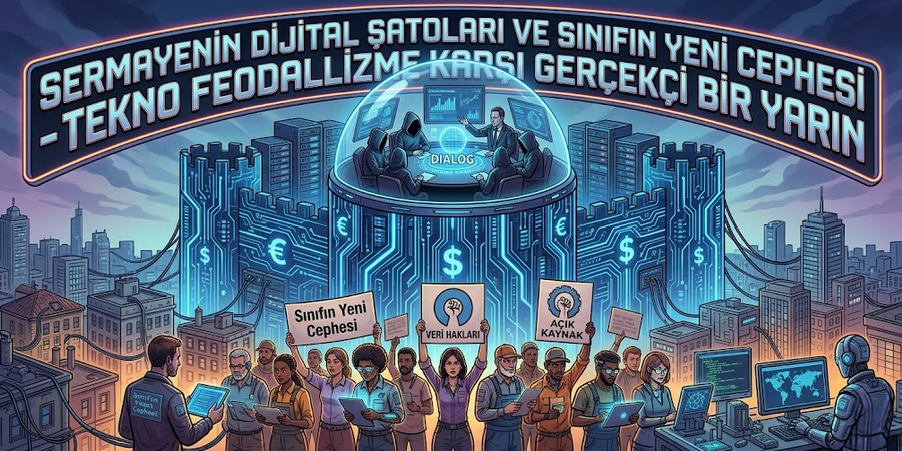
If the future is left to the interests of Silicon Valley's techno-billionaires, venture-capital funds, and proprietary states that do not watch over the public good, what awaits humanity is not simple authoritarianism, but Technofeudalism.
On this plane, the owners of digital platforms (cloud lords) will take the place of the old world's landlords; and humanity will turn into "cloud serfs" who have no right whatsoever over the data they themselves produce and who work 24/7 on digital assembly lines to pay the platform rent.
The Interest-Driven World of an Unsupervised and Anti-People Future:
- Bio-Political Enclosure: Your health data, your genetic map, and your momentary emotional state being purchased by insurance companies and finance giants. A medical-apartheid order in which, once a potential illness or your "tendency toward disobedience" is detected by algorithms, you are deprived of public transport, education, and credit.
- Cognitive Colonization: Neurotechnology (Neuralink, etc.) being made mandatory to increase the working performance of the working class. Mental-whip systems that send artificial signals to the brain of the worker—working in a factory or at a computer—when their attention wanders, that artificially postpone the need for sleep, and that adjust even rest times according to capital's production cycle.
- AI Monopolization and Mass Precariousness: Because the means of production (AI models, data centers, robotic factories) remain entirely in private property, billions of people are turned into a "surplus population." "Aquarium societies" in which, with the crumbs handed out under the name of Universal Basic Income, people are kept alive merely as passive consumers, and every kind of right to political objection is stripped from their hands.
The Algorithms of Resistance – The Public Oversight Mechanisms That Must Be Established
In the face of this dark picture, to surrender is to betray the human essence. To be resilient against dystopias means to turn their arguments inside out and build our own line of defense. The future, humanity-centered oversight mechanisms and the regulation roadmap that must urgently be put into practice against capital's greed for profit are as follows:
1. Algorithmic Nationalization and a Transparency Protocol (Open-AI Commons)
All algorithms and AI models that direct social life—used everywhere from hiring to legal decisions—must cease to be "black boxes." The source codes of all AI engines of public importance must be open and must be audited by independent committees of workers and engineers. Profit-driven algorithmic manipulations must be brought within the scope of grave crimes against humanity.
2. A Charter of Mental Privacy and Digital Inviolability
It must be fixed by universal constitutional provisions that no company, state, or algorithm can lay claim to a human's brain waves, eye movements, biometric data, and momentary feelings. Data minimization must be not a luxury but a necessity. The human's rights "to be offline," "to be forgotten," and "to leave no trace" must be made the foundation of digital citizenship.
3. Cyber-Unions and the Technology Veto
Engineers, software developers, data labelers, and content moderators must unite under the roof of globally organized Cyber-Unions. These unions must have the right to ve-to projects that would harm humanity, fuel war, leave masses unemployed and drive them into misery, or deepen the surveillance society—by using their power that comes from production.
Epic Future Fiction – "The Great Refactor" and the Collective Dawn
In the Shadow of the Silicon Walls
The year is 2089. The world was a massive technofeudal basin called "Megacity-01," rising upon the ruins of old nation-states erased from the maps, blanketing the sky with the gray smoke of enormous data towers. Humanity lived on platforms governed by the cloud lords behind the Silicon Walls. Behind every human's eye there was an implant installed at birth, called Nexus. Nexus recorded every second, scored emotions, measured performance, and turned the human into living cells of the system. Those whose score fell below 3.0 were exiled to the "Data Waste Basin" outside the walls, where they wore out their lives in lithium mines or server-cooling tunnels.
Everything looked flawless. The algorithms suppressed every possibility of rebellion while it was still at the idea stage, through neural signals. People were alone, in the isolated cells of their homes, addicted to the holographic screens before them, wearing out their lives by buying fake paradises in virtual worlds. Capital had turned the human into singular atoms.
But there was a margin of error that the system's designers forgot, that the algorithms could not calculate: the human essence—that ancient desire to be together, to share in common, which cannot be destroyed even when chained.
Scene 1: The Symphony of Headphones and the First Break
Asya was one of thousands of "mental assembly" workers employed at Content Moderation Center-12 on the lowest layer of the Megacity. Her job was, for 12 hours a day, to watch and approve or delete humanity's most traumatic, most savage images that the AI could not filter. The Nexus implant recorded even the moment she blinked her eyes, measuring her performance.
On a Tuesday night, an image dropped before Asya. In the image was a human barricade formed by workers laboring in the lithium mines outside the walls, holding hands to demand public oversight. The algorithm had labeled this image "A Threat to Social Stability" and given the destroy command.
Asya did not press the destroy button. She closed her eyes. Nexus immediately gave a warning: "Attention, cognitive lag detected. Performance is dropping." Asya removed her headphones. She looked at the worker at the next desk. That one had closed their eyes too. Then hundreds of workers behind her, to her right, to her left, set their headphones down on their desks. The sterile walls that had isolated them and turned them against one another for years were shaken by the collective murmur that arose the moment the workers removed their headphones.
That night would go down in history as "The First Refactor." The workers had not left the system; they had decided to rewrite the system itself, with their own collective power.
Scene 2: The Alliance of the Network Makers and the Collapse of the Walls
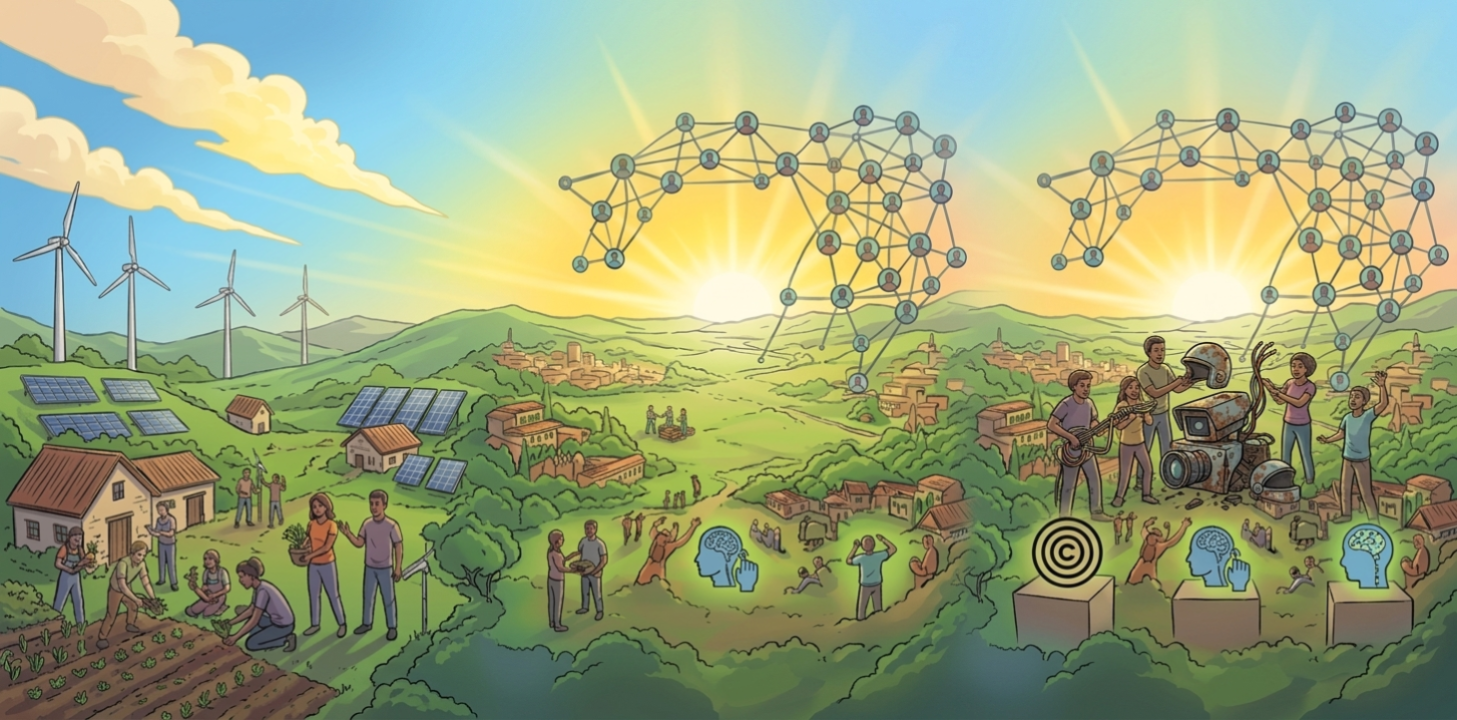
That night, Asya and her friends fled outside the walls, to the Data Waste Basin. A completely different world awaited them there. This was not that primitive, savage, mad-max-style world of destruction that the dystopia films told us about. On the contrary, this was a Knowledge Commons area without hierarchy and without property, which people had built by combining the scrap technologies in their hands.
Engineers, mine workers, former moderators, and software developers who had fled the system had come together. They called it the "Alliance of the Commons." Against the companies' closed-source software that enslaves the human, they had built a hierarchy-free communication network working on p2p (peer-to-peer) logic.
- They produced their own solar panels and ran their servers for social benefit.
- Here, AI was not a whip that supervised the human, but a liberating assistant that took on the heavy work in the mines and organized the planting in the fields.
"We are not afraid of the future," said the alliance's manifesto. "Because the future is not a fate descending from the sky; it is a commons that we code."
They found the way to reach the billions of people inside the walls. By hacking the surveillance towers the companies had built, they broadcast a single message to all screens: "The fairy tale of titles is over; we are workers. Take off your headphones, look at the one beside you. When we are together, their clouds are nothing but water vapor."
Scene 3: The Grand Compilation
When the great day came, in Megacity-01 no weapon fired, no bomb exploded. The resistance did not resemble those bloody, nihilist forms of destruction that the dystopias had taught us. This was a magnificent refactor process carried out by the collective mind of humanity.
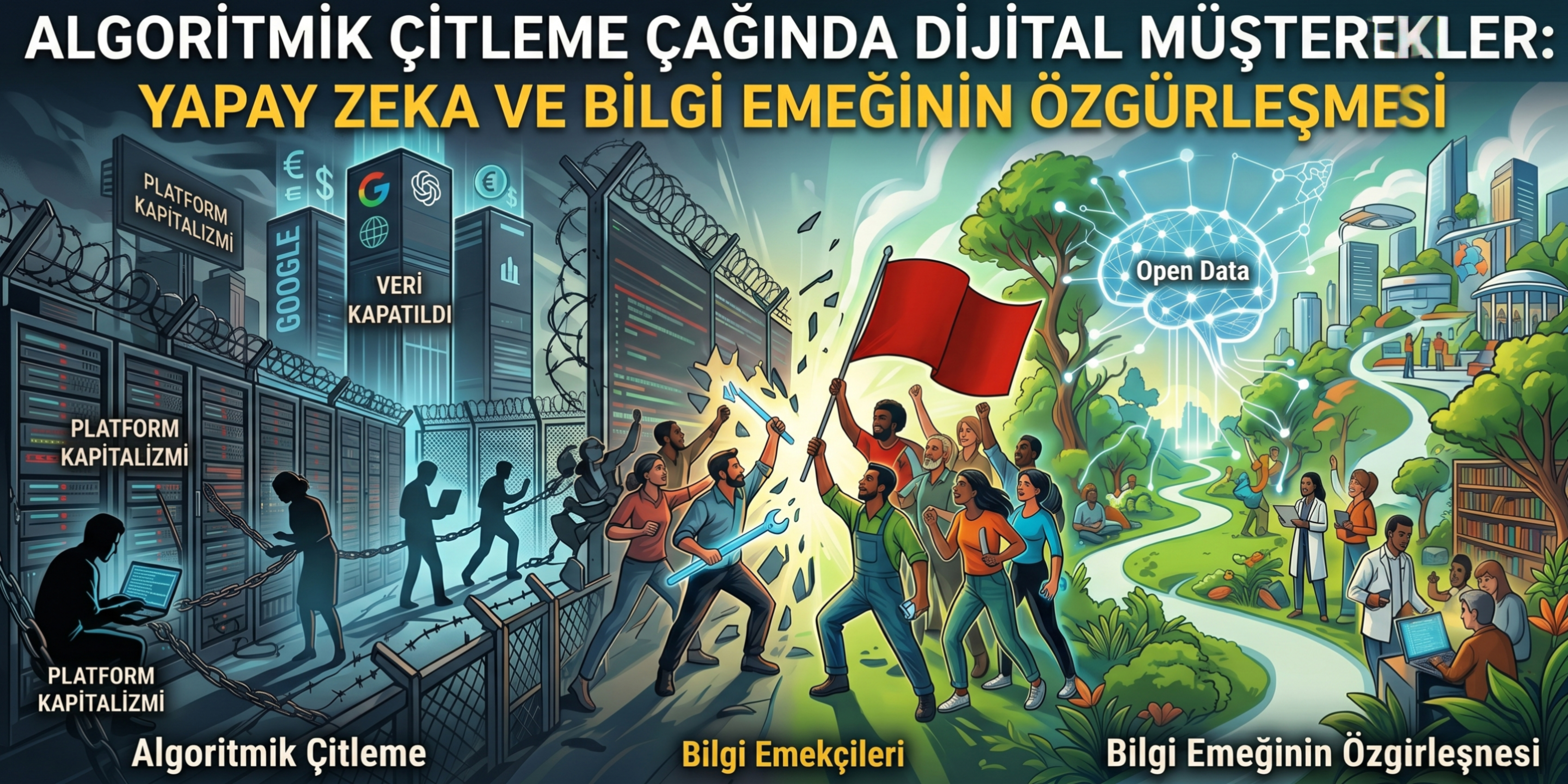
In the same second, millions of call-center workers, software developers, logistics couriers, and factory laborers shut down their systems. The companies' servers were paralyzed because the flow of data stopped. When the cloud lords could find no data to exploit, they understood how hollow an illusion their titles, stock-market values, and properties were.
People took to the streets. By holding one another's hands, they disabled the Nexus implants behind their eyes with a collective electromagnetic wave. The mirrors had been broken. For the first time, people looked at one another's faces—directly, nakedly, and with love—without the filter of screens.
The Megacity's gray, smoky sky cleared as the server towers shut down. For the first time in years, real sunlight filled the streets, reflecting off the glass surfaces of the plazas.
Epilogue: The Dawn of the Commons
Now, twenty years have passed since the Great Refactor. The planet is neither a technofeudal hell nor a primitive darkness in which technology is entirely rejected. Today the world is a World of the Commons, where production is organized for the benefit of humanity through cooperatives, where AI has reduced mandatory labor to only 1 hour a day, and where the rest of the time is left to the human—to philosophy, art, science, and love.
The human of the future looks at the old, dusty stories of the dystopias with a smile. Because they know that the thing that saved humanity was not a savior descending from the sky or a miraculous technology. The thing that saved humanity was that ancient, unbreakable will to come together, to organize, and to rewrite technology with a collective power, against loneliness, competition, and exploitation.
The black mirror was broken. The dawn is breaking. And those who write the code of that dawn are humanity itself, now holding one another's hands.