
The Future Forged at the Ankara Barricades: The Class Struggle of Private-Sector Teachers
A Class Voice Rising from the Ankara Barricades: "Education Is Not a Market Commodity — Minimum Wage Is a Right!"
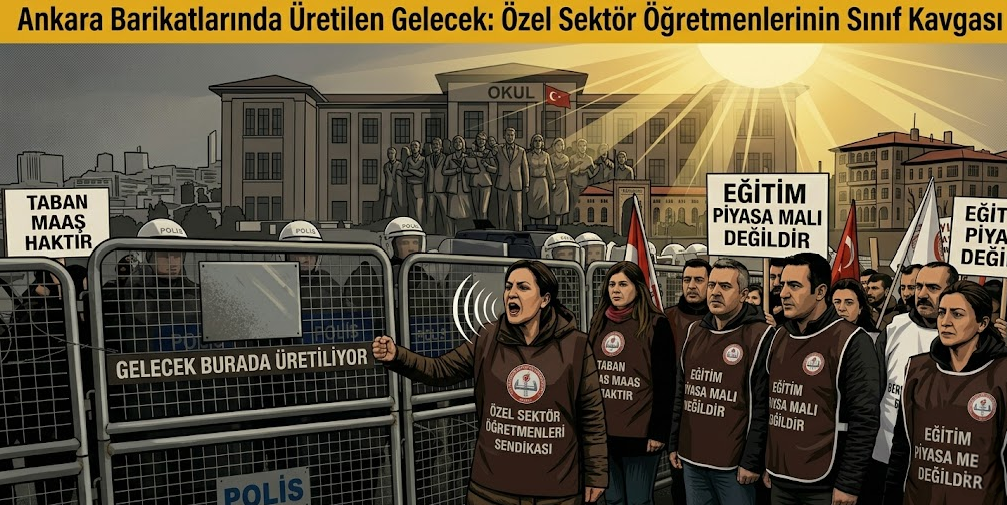
Look, comrade — I greet you with the warmth of every drop of sweat you shed at the workbench in the factory, in front of the computer screen, on the courier's motorcycle, or on a construction site. I want you to turn your eyes for a moment to Ankara, to the doors of parliament, to the streets. As a comrade fighting for the same future as you, we must read what is happening there today not merely as an "action to claim rights" but as the moment of explosion of the most naked, most savage contradictions of the capitalist order.
Come, let us speak plainly about the anatomy of this struggle — what happened, what was lived, which ideological lies the rulers clung to, and why we must stand on the side of this barricade.
What Happened, What Was Lived? Capitalist Education Factories and Naked Violence
The scene before us is concrete proof of how education has been turned into an enormous market by capitalism. Large education monopolies, through chains of sprawling campuses, chose to cut as much as possible the largest cost item in order to expand profit margins while collecting exorbitant fees from parents — namely labor power, the teacher's salary.
-
Historical Theft of Rights: In 2014, as a result of the lobbying activities of education bosses, the "Minimum Wage" law (Article 9 of Law No. 5580), which guaranteed that private-sector teachers could not earn less than their colleagues in the public sector, was taken from their hands overnight.
-
Unprecedented Exploitation: Teachers were condemned to the minimum-wage vise, and in some cases even below the minimum wage through under-the-table repayments. Only ten-month contracts were signed each year, cutting their salaries and social security during the summer months. Gratuitous labor reaching 40–50 hours per week was normalized, as were official holiday overtime.
-
The Beginning of Resistance: Teachers who refused to submit to this slavery organized under the umbrella of the Private Sector Teachers' Union, took to the streets in Ankara, pressed at the doors of parliament, and began a hunger strike. They had a single demand: the return of minimum-wage guarantees, secure employment, and humane working conditions.
-
The System's Response: The state deployed the apparatus of naked violence to protect the interests of the bosses. Teachers were dragged through the streets of Ankara, their hotels were blockaded, handcuffs were applied behind their backs, and the headscarves of women teachers were removed and their shirts torn.
This violence shows not the system's strength but its helplessness and fear. The rulers fear the contagious wave that organized action against the minimum-wage order would create — that is, the working class rising to its feet.
The Ideological Weapons of the Rulers: Fallacies and Facts
Capital's media and the bloc in power resort to three basic ideological fallacies to devalue and marginalize this just resistance in the eyes of society. We must dismantle these with class consciousness:
Fallacy 1: "Teaching is a sacred profession; it cannot be defiled with money, strikes, or the street." (The Illusion of Sacredness)
-
Purpose: To impose an ideological asceticism (self-denial) on the teacher, to render exploitation invisible behind the mask of "idealism."
-
Fact: Sacredness does not fill the stomach or pay the rent. Within capitalist relations of production, the teacher is a "worker" who lives by selling their labor power. You cannot tell the landlord or the market, "I am practicing a sacred profession." True sacredness is not submitting to injustice but rising against the order of slavery. The street is the most honorable school of labor.
Fallacy 2: "These are not teachers; they are marginal, ideological groups whose aim is provocation." (The Fallacy of Criminalization)
-
Purpose: To isolate the union from society and from parents, to suppress the quest for rights by casting it into the pot of "hostility to the state."
-
Fact: The truly marginal ones are the handful of school bosses who live in luxury on the money they earn from teachers' backs, riding in luxury cars beneath them. Yes, this movement is ideological — because it is the ideology of the working class, of labor, and of bread. Standing against exploitation with class consciousness is not a crime but a historical necessity.
Fallacy 3: "This is the private sector; if you don't like it, go to the public sector, or free-market conditions are simply like this." (The Liberal False-Choice Fallacy)
-
Purpose: To shift responsibility from the system onto the individual, to present exploitation as if it were "a natural law of the market."
-
Fact: It is the system itself that blocks the paths to the public sector through deceptive, meritless elimination mechanisms called interviews. Moreover, education cannot be a commodity left to the mercy of bosses. If education, a constitutional right, has been thrown onto the market, then the law of labor in that market must be guaranteed. The free market is not a law of the jungle that gives the boss unlimited freedom to crush the worker; we do not recognize this law!
"The human of the future will be neither a passive consumer of knowledge nor a slave who generates profit for capital. They will be the person who defends their rights, who is not alienated from their labor, and who fights at the barricade."
Why Must We Stand With This Struggle?
Now you may say: "Comrade, I am in the factory, on the construction site, or in the office — how does the teachers' struggle affect me?"
It is the dialectical rule of class struggle: When capital completely takes over one sector, crushing the others becomes much easier. If the minimum-wage right of private-sector teachers is completely seized today, tomorrow they will reach for your severance pay, your eight-hour workday, and your union rights with far greater ease. One of the greatest barricades against the rulers who want to turn Turkey into a "minimum-wage country" is the teachers today.
Teachers are the organic intellectuals of this society. They do not merely teach curriculum to children; through the honorable resistance they are waging today in the streets of Ankara, they are teaching the entire working class "How does one live as a human being, how does one claim one's rights?" If the teacher is silenced, schools will turn completely into "factories of obedience" and future generations will be mentally enslaved before they are even born.
That is why this fight is not only the teachers' but ours — the struggle of the entire Turkish working class squeezed in the minimum-wage vise and condemned to insecurity. I call on all unions and social opposition centers to set sectoral divisions aside and build a barricade of steel around the teachers.
Wherever you are, lend your voice to the voice of private-sector teachers, comrade. Remember: if they win, we win; as long as they stand tall, we will look to the future with greater hope.
Lend your shoulder, lend your voice — let us defend our future together!