
Humanity at the Apple of the Cosmos's Eye: Building the Active Future Beyond Bourgeois Nihilism
Overcoming the Nihilism Trap in the Cosmic Perspective and Building the Free Subject of the Future
In every era when humanity has turned its face to the sky, to the stars, and to cosmic horizons, a jolting ontological vertigo has been inevitable. When we discover our own temporal and spatial "smallness" in the face of the vastness of the universe—made possible by the means of modern science and technology—the human mind arrives at a great crossroads:
Should we feel the excitement of producing something new, enchanted by the greatness of the universe, or should we be seized by a feeling of nothingness that says everything is void?
Today, many popular philosophies that attempt to define the human being of the future with a cosmic perspective are, unfortunately, rapidly falling into this second path, that is, into the nihilism trap. This approach, which preaches that the actions, sufferings, and struggles of the human being are "insignificant" in the face of the greatness of the universe, may be marketed as an intellectual depth, but when viewed through the lens of historical materialism, it is subject to a very clear diagnosis:
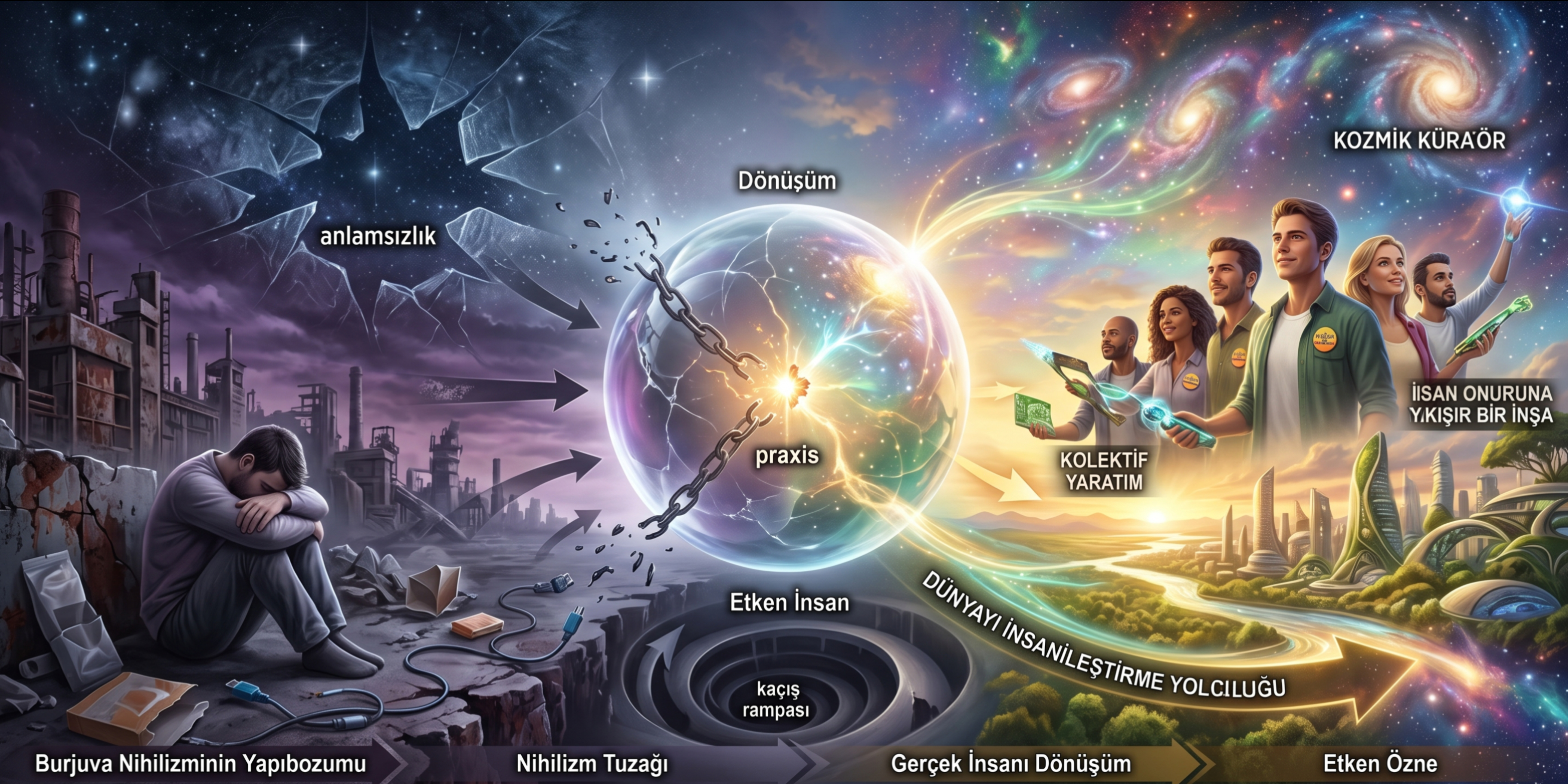
Nihilism is the philosophical escape hatch of the structural paralysis and alienation produced by capitalist society.
As a Marxist, we must draw back the curtain of this cosmic illusion, decode the class character of nihilism, and build the realistic ground that will transform the human being of the future from a passive victim into an active subject who transforms the universe.
The Outermost Limit of Capitalist Alienation: Nihilism as an Escape Ramp
Capitalism is, by its nature, a system that fragments, isolates, and atomizes the human being. The worker is alienated from the product of their labor, from the production process, from their own species-essence, and ultimately from other human beings. When this deep spiral of alienation combines with the illusion that the system has no alternative (Capitalist Realism), it creates an immense sense of helplessness and powerlessness in the individual.
It is precisely at this point that nihilism functions as a wonderful psychological safety valve for the capitalist system and as an "escape ramp" for the individual.
"If nothing has meaning, if we are merely a cloud of dust in the face of the universe, then there is no meaning in fighting against exploitation, in claiming to change the world either."
Bourgeois nihilism legitimizes political passivity by distorting the cosmic perspective. It tells the human being, "You are so small that it is not worth worrying about the injustices in the world." Thus, sufferings whose source is entirely the relations of production, class exploitation, and precarity on earth are covered with the cloak of a universal "meaninglessness." Nihilism is the act of escaping from the hell created by capitalism and taking refuge in a cosmic indifference; it is a cowardly surrender.
Albert Camus – The Stranger: The Indifference of the Reified Human
Camus's character Meursault in his novel The Stranger is one of the most refined victims of bourgeois nihilism and modern alienation. He is in a state of complete indifference toward his mother's death, his job, love, and even the murder he committed. In the face of the absurdity of the universe, everything is one and the same for him.
When we look through the Marxist sociologist György Lukács's concept of "reification," Meursault's nihilism is not a celestial enlightenment but a result of capitalist market relations objectifying human relations. In an order where people and emotions are perceived as "commodities," the individual becomes unable to mean any more to the universe than a stone. Meursault's passivity is proof of the system's success in stripping the human being of subjecthood.
Jack London – Martin Eden: The Emptiness of Individual Success
We see another tragic face of nihilism in Jack London's Martin Eden. Martin, who comes from the working class, deceived by the bright lights of the bourgeois world, climbs upward with individual determination, becomes a writer, and rises in class. But when he reaches the summit, he sees the hollowness, the hypocrisy of bourgeois intellectuals, and that everything is converted into money.
Because he acts with a relentless individualism, devoid of a collective class consciousness, nothing remains for him to hold onto in the face of this reality of capitalism. The universe and life lose all their meaning for him, and Martin Eden lets himself sink into the dark waters of the ocean. His suicide is the suicide of bourgeois individualism, hitting the wall of nihilism.
Cosmic Melancholy and Cinematic Escape Ramps
Cinema, through pixels and scenes, throws the connections between the cosmic perspective and nihilism in our faces in a much more jolting way.
Lars von Trier – Melancholia: The Bourgeoisie's Apocalyptic Fantasy
Lars von Trier's film Melancholia is the masterpiece of cosmic nihilism in cinema. There is a colossal planet (Melancholia) approaching Earth, and in the face of this cosmic threat we watch the collapse of a bourgeois family. The character Justine, played by Kirsten Dunst, is in a deep depression, and when she learns that the world will be destroyed, she experiences great relief. To her, "The world is evil, and no one will miss it."
This film is the typical apocalyptic fantasy of the bourgeois intellectual.
"It has always been easier to imagine the end of capitalism than to imagine the end of the world."
Justine's nihilism is the desire for a collective annihilation by a paralyzed class that has lost the will to change the social structure, by blaming the cosmos. It is the easy way out: if we cannot make the world a more just place, then let a planet collide and reset everything.
Everything Everywhere All at Once: From Algorithmic Escape to Active Resistance
Everything Everywhere All at Once, one of the most striking productions of the recent period, discusses the contradiction between nihilism and praxis fully at the cosmic and multiverse level. The film's antagonist, Jobu Tupaki, falls into a deep cosmic nihilism because she has experienced everything in every universe. The "Everything Bagel" she builds symbolizes that black hole in which everything actually means nothing, that is, nihilism itself. She says, "Nothing matters, because there is infinite possibility."
The film's turning point is the radical compassion and action brought by the character Waymond against this meaninglessness. Rather than escaping from the truth that everything is meaningless, the film overcomes nihilism by emphasizing the importance of touching the person beside you, transforming the present moment, and being an active subject precisely within this meaningless universe. This is a call to praxis (revolutionary action) at the micro level.
From Passive Existence to Active Subject: The Cosmic Leap of Praxis
Marx changed the direction of philosophy forever in the famous 11th of his Theses on Feuerbach:
"The philosophers have only interpreted the world, in various ways; the point, however, is to change it."
This principle also holds for the ontological definition of the human being of the future. Capitalism imprisons the human being in a passive position. The human being is an object tossed about in the wind of market fluctuations, algorithms, economic crises, and the dominant ideology. Nihilism is the philosophical acceptance of this passivity.
Real human transformation, on the other hand, is the human being taking into its own hands the power to make its own history and world, that is, transforming into an active subject. We call this Praxis; the arrival of theory and practice at a revolutionary synthesis in order to change the world.
The human being of the future, when looking at the cosmos, does not see there its own annihilation or meaninglessness. On the contrary, it sees a vast field of potential where it can see the limits of humanity's collective consciousness and productive forces (General Intellect). The cosmic perspective must compel us not to flee from the world, but to grasp the world more firmly. Because a humanity that cannot break its shackles on earth, even if it reaches the stars, will only carry there its own mechanisms of exploitation and its own rot.
Making Sense of the Future
It is precisely at this point that, against the myth of "dark and meaningless space" of bourgeois science fiction, we find the possibilities of a realistic cosmic future in literary and cinematic praxes. The antidote to the passive and destructive surrender in Lars von Trier's Melancholia is the collective labor and scientific construction in Kim Stanley Robinson's Mars Trilogy. Humanity, like the "Belters" in The Expanse, will wage the class struggle among the stars as well; yet, like the people of Anarres in Ursula K. Le Guin's The Dispossessed, it will redefine human dignity by making a propertyless and exploitation-free world flourish in the bosom of the cosmos. For the human being of the future, the universe is a mirror of conscience as in Tarkovsky's Solaris, and the ultimate site of production of the human mind as in Ivan Yefremov's Andromeda Nebula.
Kim Stanley Robinson – Mars Trilogy (Red Mars, Green Mars, Blue Mars)
This trilogy is the most monumental example of a Marxist construction of the future in literature. While narrating the colonization of Mars, Robinson takes the task out of the hands of capitalist monopolies and entrusts it to the collective will of scientists, engineers, and workers.
- In the book, Mars is not merely a geographical place; it is a laboratory in which a new social contract worthy of human dignity is built from scratch, purified of capitalism's ownership relations and ecological destruction. It is, in the fullest sense, an example of cosmic praxis (revolutionary practice).
Ursula K. Le Guin – The Dispossessed (The Anarchists)
A masterpiece that shows, against a cosmic backdrop (the planets Urras and Anarres), how property, language, and social structure can be reconstructed.
- The people of Anarres build a life worthy of human dignity in a parched and harsh desert, with no luxury whatsoever, but on the basis of "common property" and "solidarity." Le Guin does not promise us a luxurious cyber-technology; she narrates the collective construction of the active human being—freed from passivity, having taken its own fate into its hands—in the face of hardships.
Ivan Yefremov – Andromeda Nebula
This classic work of Soviet science fiction narrates the cosmic age of a humanity that has reached the higher stage of communism.
- In the work, humanity has put an end to hunger, classes, and war. It has devoted its energy to understanding the cosmos, making planets habitable, and to art. Instead of being crushed in the face of the greatness of the universe, it depicts the rational, active, and creative human being who organizes the General Intellect on a universal scale. It is the perfect antidote to nihilism.
The Expanse (Series)
One of the most realistic works of science fiction, narrating the exploitation and resistance of the mining workers (Belters) working in the asteroid belt, in a future where capital and imperialism have moved into space.
- The series shatters the "escape" illusion by showing that class contradictions on the ground will continue even if we go into space. But at the same time, it emphasizes that what keeps human dignity standing in that uncanny void of the universe is not technological toys, but the collective solidarity and organized struggle of the oppressed.
Solaris (Andrei Tarkovsky, 1972 / Stanisław Lem's Book)
It narrates humanity's contact with a colossal ocean planet possessing consciousness (Solaris), and how this contact turns into the human being's confrontation with its own conscience.
- It does not fall into the shallowness of a Hollywood-style "conquest of space" or "battle with monsters." Tarkovsky tells us that going to the remote corners of the universe does not diminish, but on the contrary increases, the human being's responsibility to protect the moral and human essence within itself. He argues that the journey of making sense of the universe is equivalent to the journey of understanding the human being and humanity.
Contact (1997)
The film, adapted from Carl Sagan's novel, addresses the scientific, philosophical, and social transformation humanity experiences after receiving a signal from space.
- While the loneliness of the human being in the face of the greatness of the universe is emphasized, this situation is not made a justification for nihilism. On the contrary, it narrates how honorable and unifying an act it is for the human species to strive to understand its place in the universe, in the light of science and rationalism. It shows that meaning will not descend from the sky, that the human being will fill that void with its own search.
A Realistic Cosmic Future: Not Escape, but a Construction Worthy of Human Dignity
The fiction of the future human being must rise on a down-to-earth, rationalist, and materialist ground. Interstellar travels, artificial intelligence symphonies, or quantum technologies cannot be mystical escape stories that sever humanity from the class realities on earth.
The cosmic journey of the human being of the future rests on a realistic ground with two fundamental stages:
Understanding and Transforming the World (The Terrestrial Foundation)
The first condition of creating meaning on a universal scale is the human being's home. A future worthy of human dignity begins with the design of a world in which hunger, wars, class domination, and exploitation have been abolished. When private ownership of the means of production is ended, humanity will spend its energy not on destroying one another or growing capital, but on solving nature and the climate crisis and enriching life. Only when a just and classless society is established on earth will the human being's "realm of freedom" begin.
Humanizing the Universe (Cosmic Praxis)
For the emancipated human being of the future, the cosmos is not the cold darkness of nihilism, but a new stage of creation where the human being's mind, aesthetics, and dignity can expand.
- Meaning Is Not Found in the Sky, It Is Produced by the Human Being: The universe may have no objective "meaning" in itself; but this situation is not a source of despair, on the contrary, it is an emancipating truth. The one who will give meaning to the universe is the human consciousness that perceives it, transforms it, and produces art, science, and philosophy there.
- The Human Being as Cosmic Curator: The human being of the future is not a passive spectator who submits to the blind forces of nature and the universe. It is an active architect who reorganizes the matter of the universe in accordance with human dignity, aesthetics, and the continuity of collective life.
The one who will give meaning to the universe is the human consciousness that perceives it, transforms it, and produces art, science, and philosophy there.
Mode of Existence The Capitalist / Nihilist Human (Camus/Trier Style) The Socialist / Active Human Being of the Future View of the Cosmos "The universe is so vast, I am insignificant, nothing has any meaning." (Meursault / Justine) "The universe is a potential waiting to be explored and made meaningful by human consciousness." Mode of Action Passive consumption, alienation, cynicism, and political indifference. Active production, collective solidarity, revolutionary praxis, and the will to transform. Cultural Reflex Escape literature, dystopias, apocalyptic fantasies. Collective human creativity, the art of humanizing the universe. Goal Surviving within the limits of the system or escaping into virtual worlds. Spreading human dignity first to the world, then to the entire universe.
Conclusion: Changing the World While Gazing at the Stars
Nihilism is the most insidious narcotic the bourgeoisie has injected into humanity. It seeks to show us the infinity of the sky and make us forget our chains on the ground. To surrender to the darkness of Melancholia or to Meursault's indifference is to bow to the status quo.
Yet through a Marxist eye, the human being of the future is neither a nihilist who, frightened by the greatness of the universe, withdraws into itself, nor a dreamer deceived by the technological illusions of capital. It is realistic enough to break the wheel of exploitation in the world, and visionary enough to carry humanity's collective intelligence to the remote corners of the universe.
Our journey is not a journey of escape from the darkness of meaninglessness. Our journey is a journey of organizing consciousness, justice, aesthetics, and human dignity in this universe consisting of blind matter, of humanizing the universe. And this journey begins not in the heavens, but in the active struggle we wage right now against the exploitation on the very soil we tread.