
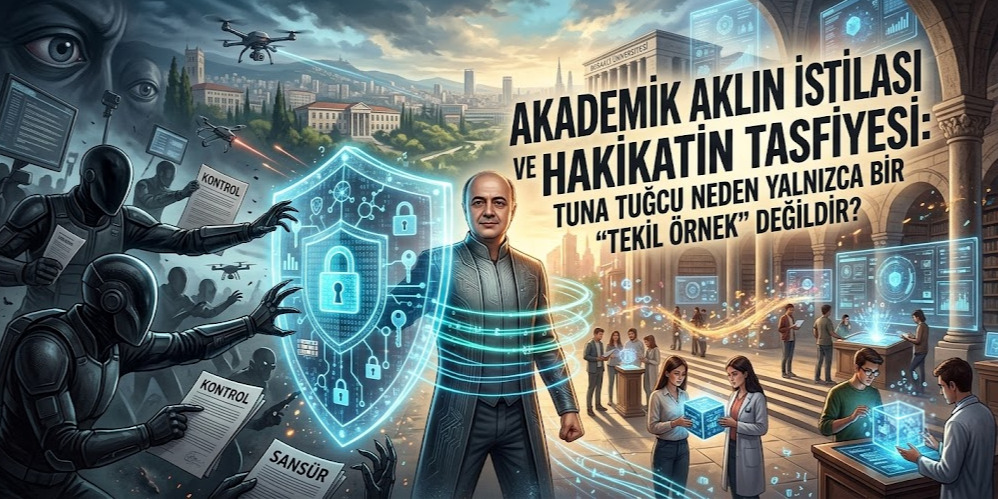
The Invasion of the Academic Mind and the Liquidation of Truth: Why Is Tuna Tuğcu Not Merely an "Isolated Case"?
Capital's Appetite for Data, Bureaucratic Violence, and the Historical Necessity of Scientific Partisanship
The dismissal from public service of Prof. Dr. Tuna Tuğcu, a faculty member of the Boğaziçi University Department of Computer Engineering, by decision of the YÖK High Disciplinary Board, cannot be read—as liberal academics claim—as a simple "administrative injustice," a "violation of law," or "the personal ambition of the trustee rector." This move is an inevitable result of the strategy of capital and the state apparatus, which is its executive committee, to establish totalitarian control over the production processes of knowledge and to de-skill academia.
On Not Becoming a Slave to the Global Techno-Oligarchs: An Interview with Prof. Tuna Tuğcu

This video is highly important because Prof. Dr. Tuna Tuğcu recounts, in his own words, his stance during the Boğaziçi resistance, the mobbing processes he endured, and why we must defend academic independence against the global technology oligarchs.
Lenin, in The State and Revolution, reminds us that the state is a product of the irreconcilable contradictions between classes and an instrument of oppression of the ruling class. Today universities are not merely spaces where the dominant ideology is reproduced; they are at the same time intellectual factories where data, technology, and—in Marx's expression—"the general intellect" are directly integrated into the processes of capital accumulation. The Tuna Tuğcu affair stands precisely at this epistemological and structural crossroads.
Epistemic Autonomy and Capital's Appetite for Data
The real historical background to Tuna Tuğcu being placed in the crosshairs is his scientific and ethical resistance, in 2022, against the security vulnerabilities in the university's information systems and against the uncontrolled opening of data to third parties and commercial companies. As a computer engineer, Tuğcu objected to the commodification of knowledge and to the offering up of public data to capital's plunder.
- Commodification and Alienation: Marx, in Capital, while describing the process of commodifying objects, reveals how human labor and its products become alienated from their producer. Today the moves carried out in universities under the name of "technological transformation" and "digitalization" consist, in fact, of placing academic knowledge production and university infrastructure at the service of the international technology oligarchs.
- The Absurdity Stage of the Ruling Class: To expel a computer professor by accusing him of "deliberately obstructing the functioning of information systems" is proof that the ruling class has lost its ability to establish hegemony and has passed into a stage of pure bureaucratic violence. A scientist who defends the system's technical and public security has been declared a threat to the system itself; because that system now serves not science, but rent and political control.
Why Must We Defend Tuna Tuğcu?
To defend Tuna Tuğcu is not a liberal "solidarity of victimhood" or an abstract panegyric to academic freedom. This defense is an epistemological necessity and a class barricade.
- The Defense of Truth: Not only Marx and Engels, but the Soviet philosophical tradition as well (for example, Evald Ilyenkov's dialectical epistemology) emphasize the bond of knowledge with practice and the role of objective truth in social liberation. To defend Tuğcu is to stand against the liquidation of objective truth and merit by bureaucratic ignorance.
- The Protection of the Public Sphere: Universities are arenas of conflict within the bourgeois state. The struggle for the autonomous university is the struggle to protect the historical gains and the intellectual arsenal of the working class. To turn a blind eye to Tuğcu's liquidation is to accept that academia becomes wholly a "technocratic slave camp."
"De-Skilling" as a Global Tendency
This practice that the current government applies at Boğaziçi is, beyond a local belligerence, a structural tendency of global capitalism. As Harry Braverman examined in depth in Labor and Monopoly Capital, capitalism must continually fragment labor, render it controllable, and de-skill it.
The reflection of this global strategy in universities manifests itself in three stages:
- The Fragmentation of Intellectual Labor: Qualified academics who think critically, who question, who expose the system's structural faults are liquidated. In their place, the aim is to substitute "technical functionaries" who carry out the orders given, who enter data, and who do not question.
- Manageable Ignorance: States and capital do not want unpredictable intellectuals who do not even obey the rules they themselves set. What they need is a docile, de-skilled academic cadre that has accepted the domination of the global technology lords.
- Academic Proletarianization: It is the precaritization of professors, their expulsion by arbitrary decisions, and the complete dispossession of intellectual labor by severing it from the means of production (its laboratory, its chair, its university).
Conclusion: Epistemic Resistance, Digital Publicness, and Claiming the Future
Lenin, in his philosophical masterwork Materialism and Empirio-criticism, declared that science and philosophy can never be "neutral," and that behind every epistemological debate ultimately lie class interests and partisanship. Today, at the dawn of the digital age, this warning of Lenin's has taken on a more concrete reality than ever. In the 21st century, data is not merely abstract digital codes; it is the objectified form of social life, of collective labor, and of humanity's "general intellect." Therefore, to claim the university's data is to defend the borderlands of the public against capital's new moves of primitive accumulation.
The appetite of the current oligarchic structure and the collaborationist bureaucracy to sell off the digital infrastructure at Boğaziçi University, and the private and intellectual data of students and academics, to capital is precisely an indication of this ruling-class savagery. The commodification of data and its opening to the plunder of international monopoly capital means the complete intellectual dispossession of academia and society. This data belongs to the public, to the people; selling it off to international technology companies or partisan capital groups is a shackle struck upon the common future of humanity.
It is precisely at this point of rupture that the historical greatness and unshakable stance of Prof. Dr. Tuna Tuğcu crystallizes.
Professor Tuna did not, as a mere computer engineer, prevent a technical manipulation; on the contrary, by reminding us of the historical and moral responsibility of science and the scientist in the face of capital, he displayed epistemic vanguardism and leadership. With the voice he raised from his laboratory and his chair, he erected a dialectical barricade against the transformation of technological knowledge into an instrument of domination in the hands of the rulers.
This will that Tuna Tuğcu displayed is a modern manifestation of the consciousness of "the social and economic roots of science" pointed to by the Soviet philosopher of science Boris Hessen. He is the symbol of a new-generation scientific avant-garde that does not bow before capital's digital siege, that defends truth and the public interest.
For this reason, defending Tuna Tuğcu is for us not a temporary practice of solidarity, but a historical, philosophical, and class necessity. As those who defend truth, who refuse to surrender their data to monopoly capital, and who will not let the dignity of academia be trampled, we will walk on this line of resistance opened by Professor Tuna—together with him, to the very end, unshaken and without retreating a single millimeter. The lies of the rulers and their bureaucratic liquidations will never be able to overcome this barricade of truth, which is organized and grounded in science.
We are here, we are beside Professor Tuna; we will not surrender academia to capital, nor our data to the monopolistic siege!
You may also be interested in...