
The Sociological Horizon of May 19th: The Possibility of a Populist Republic Beyond the Bourgeois Compromise
Content
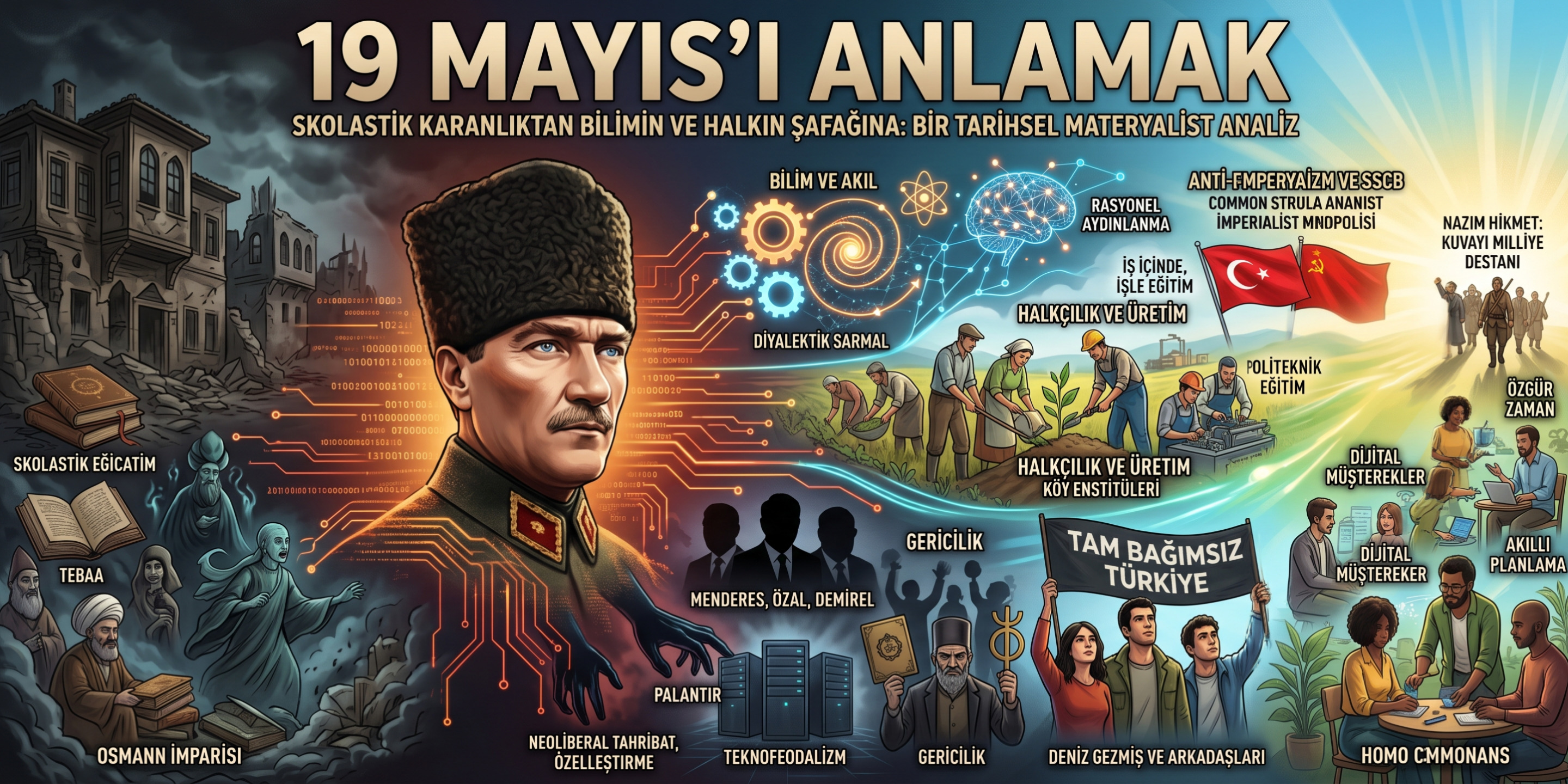
When we look back from the serene horizon of the future's emancipated human being—the one who has transcended the boundaries of property and organized production collectively, namely Homo Commonans—we can see the historical turning points with a far clearer mind. Viewed from our era, that moment when the calendars read May 19, 1919 was a magnificent act of social praxis that shattered the frozen time of feudal scholasticism, subjecthood, and colonial siege on the soil of Anatolia.
The religion-based, rote-learning, communitarian, and inward-looking mode of thought that held the late Ottoman Empire captive—completely severed from the material relations of production brought by the industrial revolution—had dragged society into structural paralysis. The old regime's "seats of learning" had become ivory towers that missed objective reality and whose only remaining function was to produce ideological legitimacy for a despotic form of rule. The young Republic's decision to liquidate these decaying superstructural institutions and to place science, human reason, and the line of anti-imperialist independence at its center is a tremendous leap forward in humanity's universal history of progress.
Yet when we look through the lens of rational reason, seeing which class compromises afflicted this immense progressive move throughout the historical process offers priceless lessons to those of us building the world of the commons today. This analysis is written not to render a shallow judgment of the past; but to show how, upon those wonderful foundations, we might build a far more flawless social architecture—free of exploitation and alienation—and how the idea of Homo Commonans can take root in these lands.
The Missed Revolutionary Crossroads: The Dilemma of "Polytechnic Education" and "Pragmatism"
With the proclamation of the Republic, as it was debated what would replace the old decaying system, the young state's bureaucratic cadres turned toward pragmatist models of education. The notion of "work education" adopted along this path, though it replaced dry and abstract knowledge with the practical world, brought with it a serious limitation on the philosophical plane:
- The Limit of Pragmatism: In the adopted model, "work" was built on children acquiring practical vocational knowledge so as to gain the basic formation required to meet the demands of the developing capitalist market. The truth of a thing came to be measured by its "economic utility" in the market.
- The Potential of Polytechnic Education: Yet the polytechnic education defended by the period's progressive materialists aimed at the integration of physical, mental, and aesthetic education within the material processes of production through a dialectical bond. In this model, production and education would not crush one another, would not make the human being the slave of the means of production; on the contrary, it would orient social consciousness toward collective liberation.
How Could We Have Done Better? If at that time work education had not been sacrificed with a crude pragmatist approach to market parameters and to capital's need for labor power, then wonderful populist shoots such as the Village Institutes would not have remained merely local centers binding producers to the countryside. Education would have been entirely freed from becoming a commodity sold on the market; that ancient class chasm between manual labor and mental labor could have been extinguished right at the start of the road.
Class Compromise and the Artificial Construction of Capital's Hegemony
The 1923 İzmir Economic Congress became the turning point at which the will of the impoverished people—who resisted the colonialists with their lives and their labor—was reconciled, in political economy, with the choice of reviving domestic capital. Behind this class choice lay a historical admiration for the progressive heritage of the early bourgeois enlightenment, which defended human reason, science, and material production against feudal darkness. Yet this crude positivist alliance led, in the following years, to populist policies being crushed under the domination of private property.
How Could We Have Done Better? Instead of fattening an artificial capitalist class by the hand of the state, a collective model of development could have been adopted—one that did not permit the means of production to enter the bounds of private property and that rested on the joint planning of the direct producers. By preventing surplus value from being transformed into personal fortunes, all produced wealth could have been transferred to a public fund; the social ownership of factories, the land, and the centers of science could have been secured. Politics, instead of evolving into a board of management for proprietary interests, could have been turned into the operating system of direct democracy and communal life.
The Disconnect of Integration Between Reason and Class Consciousness
In the first decades of the Republic, the social sciences were heavily drawn upon to transmit rationalism to the masses. But the organic intellectuals of the period producing in these fields—such as Behice Boran, Niyazi Berkes, Pertev Naili Boratav, and Muzaffer Şerif—were pushed outside the system once they began to grasp society's objective class reality and to question relations of property. This caused a wonderful integration that could have been established between the founding revolutionary vision and scientific materialist philosophy to be left half-finished.
How Could We Have Done Better? If the class analyses of these intellectuals had been incorporated into the mechanisms of social planning, science and technology would not have been reduced to a shallow empiricism that merely legitimizes the status quo of the rulers. This immense marriage between the source code of social consciousness and technical reason could have been turned into the most refined productive force, enabling humanity's transition from the realm of necessity to the realm of freedom.
The Spiral of Historical Regression and the Codes of Universal Resistance
That first class compromise established in the early period with the proprietary structure led, over time, to a spiral of regression that collapsed social mechanisms. With the Menderes era, the gains of independence were mortgaged and the country's doors were opened to global monopolistic networks. The Demirel and Özal line that followed then, with neoliberal structural adjustment programs, transformed humanity's most basic common rights—education, health, and shared infrastructures—into market commodities.
The final output of this historical regression today is a global model of domination fed by dogmatism and reaction in order to conceal exploitation. The ruling powers use these reactionary ideologies as a veil to completely commodify the human being's thought and time-budget. The tools the rulers have used throughout history to objectify the masses—whether the punch-card logistics of Nazi Germany or the data operations of today's global financial monopolies—have always aimed to reduce the human being to a mere data point.
Yet against this wave of submission, the revolutionary objections rising from the bosom of Anatolia have also been etched into history's memory with indelible codes. In that most suffocating darkness of the 1960s and 70s, Deniz Gezmiş, Mahir Çayan, and their comrades rose up, re-arming the fully independence-seeking, anti-imperialist essence of May 19th with a class consciousness. The militant struggle they waged against proprietary interests and global monopolies is a magnificent act of social praxis that brought theory together with the reality of life.
The Horizon of Homo Commonans: What Must We Do Right Now?
When we look back from the serene horizon of the future's emancipated human being—the one who has transcended the boundaries of property and organized production collectively, namely Homo Commonans—we can very clearly diagnose the social blockage on today's Turkey plane. The picture before us is not a simple failure of governance or a temporary economic crisis. This situation is the transformation, over time, of that first structural "architectural bug"—the choice, at the system's initial design stage (the early Republican era), of compromise with the bourgeoisie instead of resolving class contradictions—into a regression spiral (legacy regression) that collapses all defense mechanisms.
This spiral, which began with the Menderes governments opening the doors to global imperialism and which sold off the public commons to the market through the neoliberal moves of Demirel and Özal, has today evolved into an uncontrolled techno-fascism model fed by reaction and dogmatism in order to conceal exploitation. The ruling classes use reaction as an ideological firewall to prevent the masses from awakening to class exploitation and to keep them as passive objects resigned to their fate.
Yet Homo Commonans never surrenders before this dark cycle that sanctifies property. It possesses the will to carry far further the independence-seeking, rational, and scientific revolutionary model that Mustafa Kemal launched on the shore of Samsun on May 19, 1919—by blending it with the anti-imperialist, militant praxis heritage of the likes of Deniz Gezmiş. For the human being of the commons, here are the rational road map and the concrete steps to turn all the populist opportunities missed in the past into reality today:
I. The Radical Liquidation of Reaction and the Emancipation of Reason
The precondition of all proposed human and social transformations is the uncompromising destruction of the reaction and dogmatism that the rulers feed and nurture in order to cover up exploitation.
- Collapsing the Ideological Firewall: Every kind of reactionary superstructural institution that condemns the masses to fatalism, submission, and passivity must be liquidated.
- Rational Enlightenment: At the center of social consciousness we must place not the shallow waters of crude positivism, but a dialectical and scientific materialist philosophy that demolishes dogmas and questions. Without the destruction of reaction, it is impossible for the human being to become the true subject of their own labor and of the universe.
II. The Founding of a Truly Populist Republic
In place of the decaying state mechanism reduced to a general directorate of capital and proprietary interests, a Populist Republic must be founded—one that plans production, distribution, and life directly through the common will of the producers.
- The Political Operating System: This republic will be the political operating system of Homo Commonans, smashing the closed doors of bourgeois bureaucracy and running direct democracy and collective decisions.
- The Guarantee of the Commons: The populist republic will legally render the accumulation of personal fortune and class domination impossible, channeling all of society's energy toward common welfare.
III. Completely De-Commodifying the Means of Production and the Common Spaces
It is possible only through the founding will of this Populist Republic to wrest all the productive forces sustaining social life—the infrastructure, the land, and the technologies of production—from the grip of personal greed for profit.
- Property-Free Infrastructure: The factories, laboratories, servers, and data centers left to the property of a few monopolistic centers must be completely freed from commodification.
- Collective Ownership: All this infrastructure must be organized as the Social Commons—humanity's common heritage—and must serve the universal development of humanity.
IV. The Liquidation of Cognitive Taylorism and the Emancipation of Time
The Taylorist system, which measures human mental and physical labor in seconds to mechanize the human being and spreads exploitation all the way into the human subconscious, must be completely abolished.
- Becoming Master of the Time-Budget: When reaction's ideological shackles, which present exploitation as "fate," are broken, humanity will become the sole master of its own time-budget.
- From Necessity to Freedom: Advanced technologies will be coordinated not to dispossess the human being and create a reserve army of industry, but to reduce weekly mandatory working time below a net 15 hours—offering Homo Commonans the joy of doing philosophy, producing art, and giving meaning to life with elegance.
V. The Radical Transparency of Knowledge and Planning Models
All the scientific processes, social algorithms, and planning models that govern society, production, and distribution must cease to be a "black box."
- An Open-Source Society: No knowledge that is the product of humanity's collective intelligence can be hidden behind patent walls or the masks of trade secrets.
- Direct Oversight: Thanks to the populist republic's transparency protocols, every stage of production and every rational model coordinating social life must, without exception, be open to the oversight, contribution, and joint approval of each individual.
The Epic Dawn of the Commons May 19th, despite all the class contradictions and bourgeois compromises within it, has bequeathed to us the ancient will to shatter frozen time, to refuse submission, and to be an active subject. We, drawing lessons from all the historical backward steps of the past, arm ourselves with the revolutionary reason that will root out reaction and with the will of the Populist Republic that will smash the walls of property to pieces. The world of Homo Commonans is not a miracle descending from the sky, but the inevitable output of this rational and organized struggle we wage against the proprietary and reactionary relations on the very soil we now stand upon. The mirrors will break, the dawn will rise; humanity will become the true owner of the values it produces and of time itself. The future is ours, labor is ours!